Quick answer: Analysis of Vancouver rental property returns in 2026 across condos, townhouses, and multiplexes. Updated July 2026: condo benchmark $695,200 (June GVR data), 1BR average rent $2,362/month (Rentals.ca Jan 2026), vacancy rate 3.7% (CMHC — highest since 1988). Condo cap rate ~2.6%, negative cash flow persists. Multiplexes offer the best cap rates at 3.5–4%. BoC held at 2.25% June 10, 2026.
With condo prices down 6.8% and vacancy rates rising, is 2026 the right time to buy a Vancouver rental property? I run the actual numbers on purchase costs, cash flow, and cap rates across three property types.
Want a free assessment for your property?
Leave your name and phone — Greyden will call you back with a personalized market snapshot. No spam, no drip campaigns.
Join 1,000+ Vancouver homeowners. No spam, unsubscribe anytime.
I get asked some version of this question at least three times a week: “Greyden, should I buy a condo as a rental investment right now?” The honest answer is more complicated than most people want to hear. Condo prices in Metro Vancouver have dropped 7.1% year-over-year to a benchmark of $695,200 according to Greater Vancouver Realtors’ June 2026 data. That sounds like a buying opportunity. But cheaper purchase prices do not automatically mean good returns, and the rental math in Vancouver has always been brutal for condos. In fact, with vacancy rates at a 38-year high and rents falling, the math has gotten harder, not easier.
Let me walk through the actual numbers. No hand-waving, no “it depends” — just a straightforward look at what each property type actually returns in 2026. Updated July 2026.
The Vancouver Condo: Running the Real Numbers
Here is a typical scenario for a one-bedroom condo purchased as a rental in 2026.
Purchase assumptions:
- Benchmark price: $695,200 (GVR June 2026 condo benchmark)
- Down payment: 20% ($139,040) — required minimum for investment properties
- Mortgage: $556,160 at 4.5% fixed, 25-year amortization
- Monthly mortgage payment: approximately $3,075
Monthly expenses:
- Mortgage: $3,075
- Strata fees: $475 (typical for a newer 1BR; older buildings run $400–600 per Strata Property Agents of BC data)
- Property tax: $174 (roughly 0.3% of assessed value annually, divided by 12)
- Insurance: $50 (landlord policy)
- Maintenance reserve: $100
- Vacancy allowance (5% — more realistic given 3.7% vacancy rate): $120
- Total monthly cost: $3,994
Monthly income:
- Average 1BR rent in Vancouver: $2,362 per month according to Rentals.ca January 2026 National Rent Report — down 6.3% year-over-year; downtown 1BRs average $2,457
Monthly cash flow: -$1,632
That is negative sixteen hundred dollars a month. Every month. You are paying $19,584 per year out of pocket to own this investment. And that does not include the opportunity cost of your $139,040 down payment. The math got harder in 2026, not easier — prices fell but rents fell faster, and vacancy has risen to its highest point since 1988.
But What About Equity Buildup and Appreciation?
Fair point. Let me account for those.
Of that $3,075 monthly mortgage payment, roughly $985 goes toward principal in year one (the rest is interest at 4.5%). That is forced savings — real equity you are building. Over 12 months, that is about $11,820 in principal paydown.
Appreciation is trickier. Condo prices have fallen 7.1% over the past year. CMHC’s 2026 Housing Market Outlook projects marginal price growth, but the condo segment is specifically flagged for elevated new supply pressure. Let me be generous and assume 2% annual appreciation on the $695,200 purchase: that is $13,904.
Year-one total return picture:
- Cash flow loss: -$19,584
- Principal paydown: +$11,820
- Appreciation (assumed 2%): +$13,904
- Net return: +$6,140 on $139,040 invested = 4.4% return
Worse than last year’s math on paper, and still dependent on appreciation materializing. If appreciation comes in flat — which CMHC’s own data on unabsorbed condo supply suggests is plausible — your return drops to negative 5.6%. You are carrying $1,600+ per month in negative cash flow against an uncertain bet on price recovery.
Cap Rates Tell a Sobering Story
The cap rate strips out financing and just asks: what does the property earn relative to its value?
For our condo example: annual net operating income (rent minus expenses, excluding mortgage) is roughly $2,362 x 12 = $28,344 in gross rent, minus about $11,208 in operating expenses (strata $5,700, property tax $2,088, insurance $600, maintenance $1,200, vacancy at 5% = $1,417, minor repairs $203). That leaves $17,136 in NOI.
Cap rate: $17,136 / $695,200 = 2.46%
A 2.46% cap rate is worse than last year’s already-grim 2.75%. GICs are paying 3.5–4% with zero tenants and zero strata drama. The only rational case for a 2.46% cap rate is a firm conviction in near-term price appreciation. Given that CMHC is specifically flagging completed and unabsorbed condo inventory increasing across Metro Vancouver, that conviction should be well-supported before you commit capital.
The Townhouse Option: Better Math, Less Supply
Townhouses in Metro Vancouver benchmarked at $1,046,200 in June 2026 (GVR data). They are pricier to buy, but the rental economics work differently.
Townhouse rental scenario:
- Purchase: $1,046,200, 20% down ($209,240)
- Mortgage: $836,960 at 4.5%, 25-year = ~$4,625/month
- Strata fees: $350 (townhouse stratas tend to run lower)
- Property tax: $261/month
- Insurance + maintenance: $175/month
- A 3BR townhouse in a decent location rents for $3,200–$3,800/month. Call it $3,400 (rents have softened).
Monthly cash flow: -$2,011
Worse cash flow than the condo. But the appreciation thesis is fundamentally stronger: townhouse prices dropped only 5.0% year-over-year versus condos’ 7.1% (GVR June 2026 stats), and the demand recovery is running fastest in this segment. The supply-demand picture for townhouses is tighter. Families need them, and not enough are being built.
Cap rate comes in around 2.2%, which is marginally better than condos. Townhouses as pure rental investments only make sense if you are betting on appreciation and can stomach negative cash flow for years — but the appreciation story is better-supported here than in the condo segment.
The Multiplex Advantage: Where the Numbers Actually Work
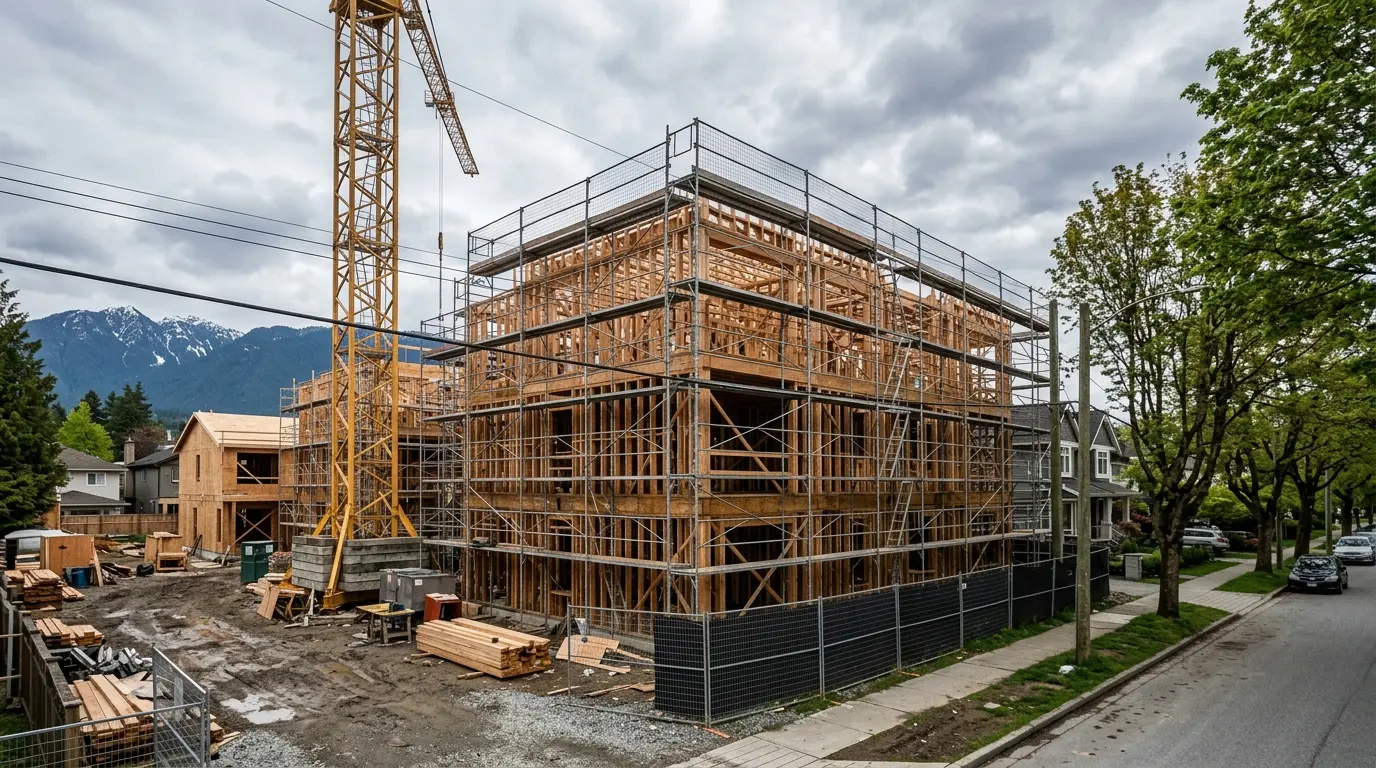
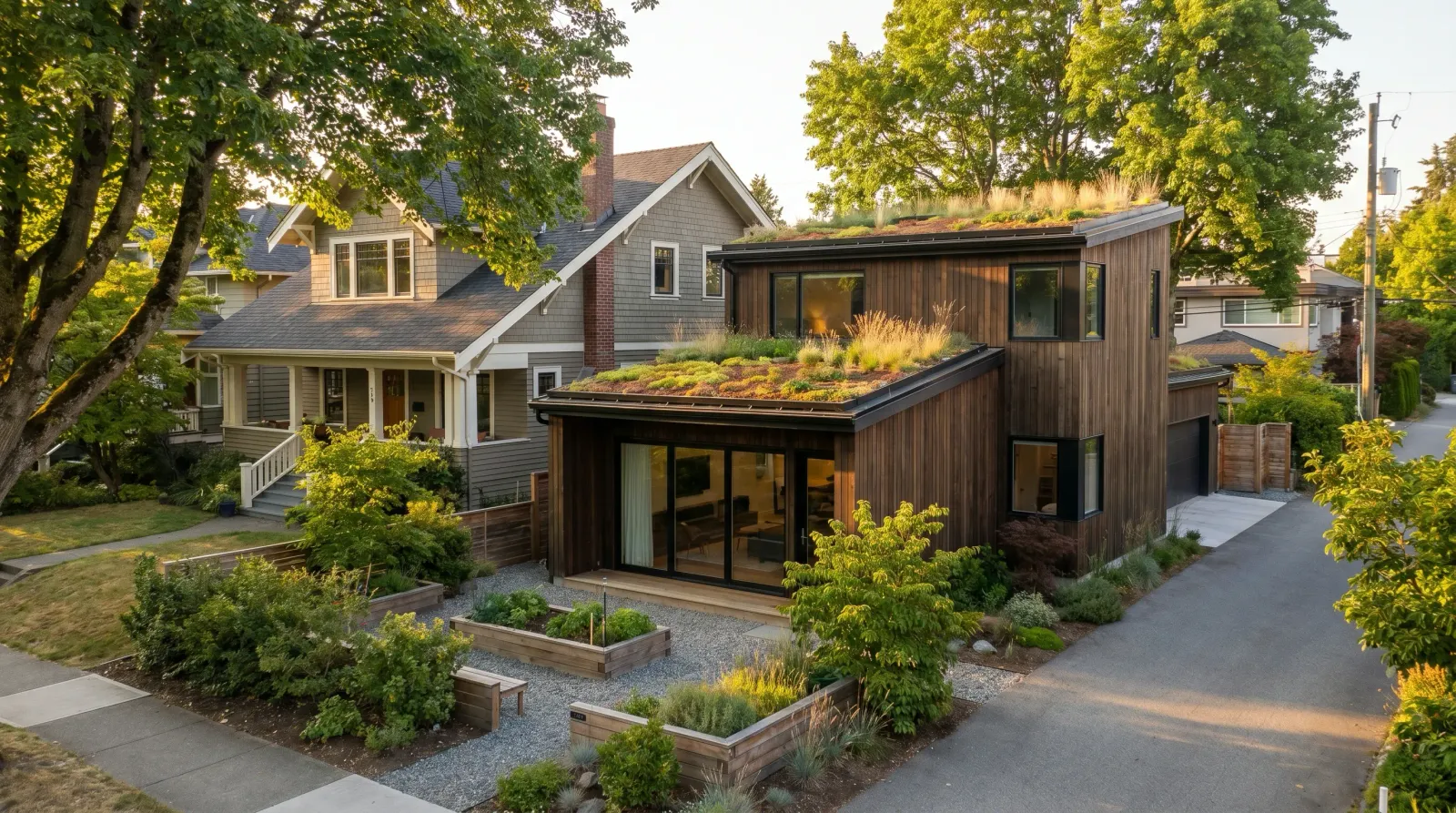
This is where I get genuinely excited, and it is a conversation I have been having with more investors over the past year. Under Vancouver’s multiplex zoning rules, you can now build up to six units on lots previously zoned for a single-family home.
Multiplex investment scenario (4-plex, new construction):
- Total development cost: approximately $2,400,000-$3,000,000 depending on lot location, size, and build quality
- Let me use $2,700,000 as a midpoint for an East Vancouver lot
- Four units renting at an average of $2,800/month each = $11,200/month gross
- Annual gross rent: $134,400
Annual expenses (no strata — you own the whole building):
- Property tax: ~$675/month ($8,100/year)
- Insurance: $400/month ($4,800/year)
- Maintenance reserve: $600/month ($7,200/year)
- Vacancy allowance (3%): $336/month ($4,032/year)
- Property management (8%): $896/month ($10,752/year)
- Total operating expenses: ~$34,884/year
NOI: $134,400 - $34,884 = $99,516 Cap rate: $99,516 / $2,700,000 = 3.7%
A 3.7% cap rate is still not amazing by national standards, but it is the best you will find in Vancouver proper. And here is the real kicker: you have no strata corporation to deal with, no rental restrictions, no special assessments decided by other owners. You control the asset completely.
With financing at 4.5% on 75% of value, your annual mortgage payments come in around $134,000, which almost matches gross rent. After expenses, you are cash-flow negative, but the gap is much smaller than condos on a per-unit basis. And the appreciation potential on a purpose-built rental building in Vancouver is strong over a 10-year horizon.
What CMHC’s Vacancy Data Means for Investors
Here is the part most bulls do not want to discuss. Metro Vancouver’s purpose-built rental vacancy rate hit 3.7% in 2025 — the highest since 1988, according to CMHC’s annual Rental Market Report. In 2022 it was below 1%. That is a complete reversal in three years.
The rent decline data is just as stark. Rentals.ca’s January 2026 report shows Vancouver apartment rents averaging $2,630 per month — down 9.2% year-over-year, with 26 consecutive months of annual rent declines. One-bedrooms average $2,362 (down 6.3% YoY). Some downtown buildings are offering one month free to attract tenants.
This does not mean rents are crashing to zero. Vancouver is still expensive relative to most of Canada. But rents have genuinely declined, not just “moderated.” Plan for 1–2% annual rent growth at best over the next few years — not 5–8%. And budget for a full month of vacancy per year minimum, not two weeks.
For investors, this is the most important data point in the whole analysis. The condo cash-flow model only works if rents are rising. They are not, right now.
My Honest Assessment: Where to Put Your Money in 2026
After twenty years of watching Vancouver real estate cycles, here is my unvarnished take:
Condos as rentals are a losing proposition on cash flow. You are buying a speculative asset that costs you $1,500+ per month to hold, in a market where supply is increasing and vacancies are rising. The only scenario where this works is if you have high T4 income and want the tax write-off from rental losses, and you believe prices will rebound 15-20% within five years. That is a gamble, not an investment strategy.
Townhouses as rentals are marginally better but still cash-flow negative. The appreciation thesis is stronger because supply is genuinely constrained. If you can find one without rental restrictions in the strata bylaws — and that is a big if — it could work as a long-term hold.
Multiplexes offer the best risk-adjusted return for serious investors willing to take on the development complexity. The cap rates are higher, you control the asset, and Vancouver’s housing policy is actively encouraging this type of development. The catch is you need significant capital and patience for the 18-24 month construction timeline. But the end product is a purpose-built income property in a city where those barely exist.
If you are looking at multiplex development, I would start with our multiplex guide for a full breakdown of the process and costs.
Key Takeaways
- A typical Vancouver 1BR condo rental generates negative $1,632/month in cash flow at current prices and rents — worse than 2025
- Condo cap rates sit at roughly 2.46% — well below risk-free GIC rates of 3.5–4%
- Average 1BR rents are $2,362/month (Rentals.ca Jan 2026, down 6.3% YoY) — the math got harder, not easier, as rents fell faster than prices
- Metro Vancouver vacancy hit 3.7% — the highest since 1988; budget 5% vacancy, not 3%
- Townhouses offer better appreciation protection but worse cash flow than condos
- Multiplexes deliver the best cap rates at 3.5–4% with full owner control and no strata
- The only way condos work as investments is if you are betting heavily on price appreciation, which is uncertain when CMHC is flagging elevated unabsorbed condo supply
Frequently Asked Questions
What is a good cap rate for Vancouver rental property in 2026?
Honestly, “good” is relative in Vancouver. The city has always had compressed cap rates compared to other Canadian markets because land values are so high. Right now, condos sit around 2.5-3%, townhouses around 2-2.5%, and multiplexes around 3.5-4%. Anything above 4% in Vancouver proper would be exceptional. For context, investors in Edmonton or Winnipeg routinely see 6-8% cap rates, but those markets lack Vancouver’s long-term appreciation story.
Should I wait for condo prices to drop further before buying a rental?
Maybe. CMHC is flagging increasing completed-and-unabsorbed condo inventory, which puts downward pressure on prices. But trying to time the exact bottom is a fool’s game. I have watched clients wait for “just a little more” decline and miss genuine opportunities. The better question is: does the property cash-flow at today’s price and today’s rents? If not, a 5% price drop is not going to magically fix the math. Focus on the numbers, not the timing.
Can I use a multiplex as both my home and an investment property?
Absolutely, and this is one of the most powerful strategies available to Vancouver homeowners right now. You live in one unit and rent out the remaining three to five units. The rental income offsets your mortgage significantly — in many cases covering 60-80% of total housing costs. You also qualify for owner-occupied mortgage rates, which are lower than investment property rates. See our full breakdown of multiplex options in Vancouver for more details on this approach.
Sources
- Greater Vancouver Realtors — June 2026 Monthly Statistics
- CMHC 2026 Housing Market Outlook
- CMHC Rental Market Report 2025 — Metro Vancouver (3.7% vacancy rate)
- Rentals.ca National Rent Report — January 2026
- Rain City Properties — Vancouver Rental Market 2026: Vacancy Rates and Falling Rents
- Strata Property Agents of BC
- Bank of Canada — Rate Decision June 10, 2026
Updated July 2026 using June 2026 GVR benchmark data and January 2026 Rentals.ca rent figures.
Next Steps: Work with Rain City Properties
If you are weighing a rental property purchase in Vancouver, I would rather you run the numbers honestly before writing an offer than discover the math does not work six months in. I help investors evaluate deals every week — whether that is a resale condo, a townhouse, or a multiplex development project. The right investment depends on your capital, your risk tolerance, and your timeline.
Reach out to me directly and I will walk you through the analysis for any property you are considering.
Greyden Douglas Founder, Rain City Properties Phone: (604) 218-2289 Contact us to discuss your investment strategy.
Related resources: Vancouver Investment Guide · Multiplex Resource Hub · Presales Hub
Related Vancouver real estate pages
Continue with local service pages, neighbourhood guides, and actionable resources related to this topic.