Quick answer: Analysis of the FIFA World Cup 2026's impact on Vancouver real estate, covering short-term rental demand, property values near BC Place, Airbnb regulations, and whether the event presents genuine investment opportunities or temporary hype.
Vancouver is hosting 7 FIFA World Cup matches at BC Place in June and July 2026, with roughly 350,000 visitors expected. Here is what that means for short-term rentals, property values near the stadium, and whether the event creates real investment opportunities — or just noise.
Want a free assessment for your property?
Leave your name and phone — Greyden will call you back with a personalized market snapshot. No spam, no drip campaigns.
Join 1,000+ Vancouver homeowners. No spam, unsubscribe anytime.
The FIFA World Cup is coming to Vancouver this summer, and I’ve already fielded more calls about it than any single event in 20 years of selling real estate in this city. Seven matches at BC Place between June and July 2026. An estimated 350,000 visitors according to FIFA’s host city projections. The question everyone wants answered: does this actually move the needle on property values, or is it just a really expensive party?
My honest answer: it depends entirely on what you’re trying to do. If you own a condo in Yaletown and want to rent it out for a month, there’s real money on the table. If you’re thinking of buying an investment property specifically because of the World Cup, you’re probably too late and the math doesn’t work. Let me break it down.
What Vancouver Is Actually Hosting
Vancouver is one of 16 host cities across Canada, the United States, and Mexico. BC Place will host seven matches — five group-stage games and two knockout-round games, per the confirmed match schedule. That puts us in the upper tier of Canadian host cities. Toronto gets the most matches at BMO Field, but Vancouver’s allocation is substantial.
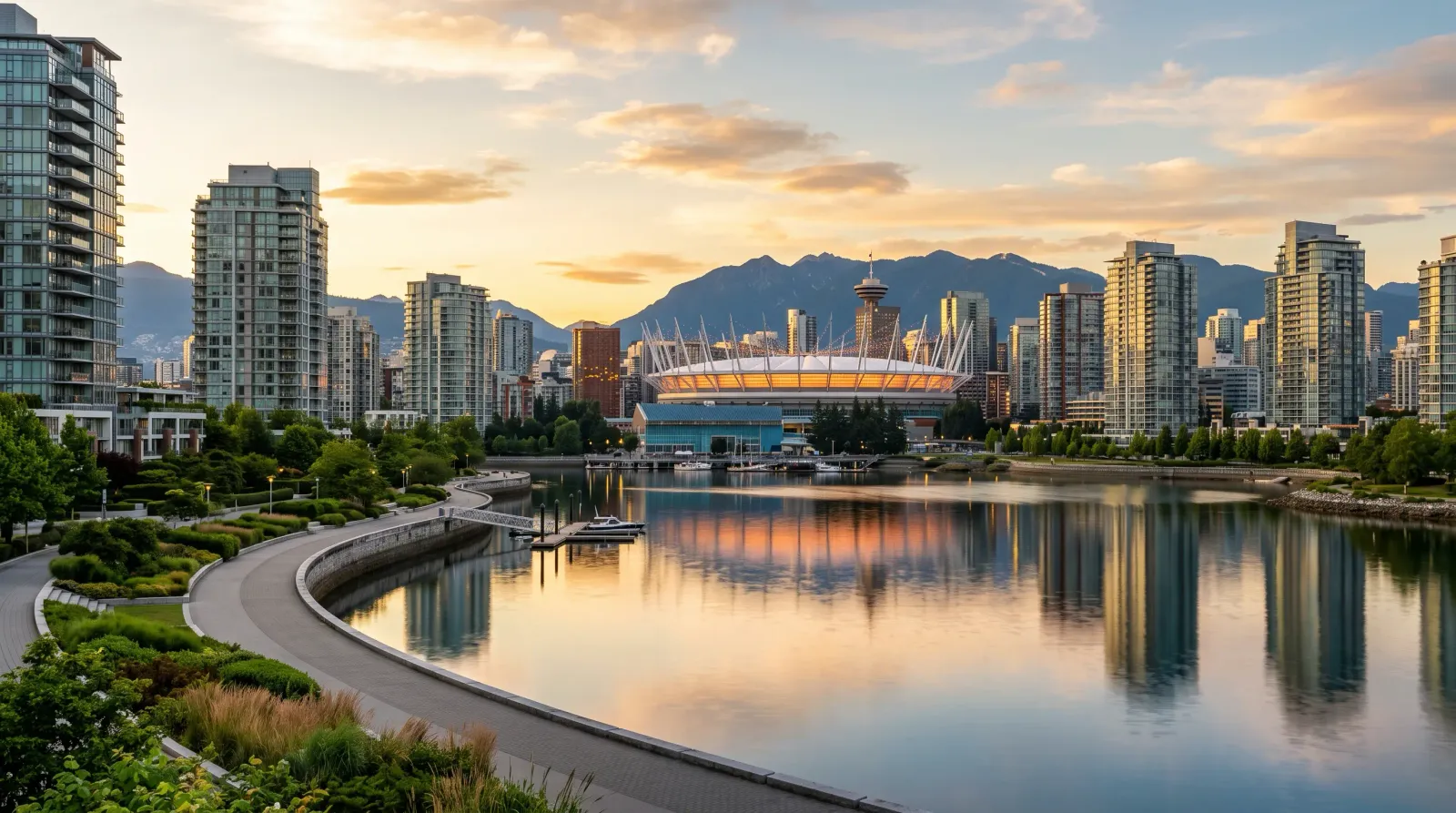
The match schedule spans roughly three weeks from mid-June to early July. That’s important context. We’re not talking about a single weekend. This is a sustained surge in visitor traffic over nearly a month, concentrated in and around the False Creek corridor.
FIFA expects approximately 350,000 unique visitors to Vancouver across the tournament window. For perspective, Vancouver typically sees about 11 million overnight visitors per year according to Destination Vancouver’s 2024 tourism data. Adding 350,000 in three weeks is meaningful — roughly equivalent to compressing a full month of normal tourism into half the time.
The Short-Term Rental Opportunity
This is where the real action is for property owners. Hotel rates in Vancouver are already projected to spike during match weeks. Tourism Vancouver’s preliminary estimates suggest average nightly rates near BC Place could hit $400-$600 during match days, roughly double the normal summer average.
For Airbnb and short-term rental operators, the math gets interesting fast. A one-bedroom condo in Yaletown that normally rents for $150-$180 per night in summer could command $300-$450 during World Cup weeks. Over a 21-day tournament window, that’s potentially $6,000-$9,000 in gross revenue from a single unit.
But here’s the catch — and it’s a big one.
Vancouver’s Short-Term Rental Regulations
The City of Vancouver restricts short-term rentals to your primary residence only, under the Short-Term Rental Accommodation bylaw. You need a valid business licence. You can only rent the home you actually live in. Investment properties, secondary suites you don’t occupy, and units in buildings that prohibit short-term rentals are all off-limits.
Enforcement has tightened significantly since the original bylaw passed. Fines for unlicensed short-term rentals run up to $1,000 per day. During a high-profile international event with hundreds of thousands of visitors, I’d expect the city to be watching closely. The political optics of letting unlicensed Airbnbs run wild during the World Cup while Vancouver deals with a housing affordability problem? That’s not going to happen.
So if you’re thinking about buying a condo just to rent it out for the World Cup: don’t. The regulatory framework doesn’t support it, and the penalties wipe out any potential profit. If you already live in a condo near BC Place and want to travel for a few weeks in June, listing your primary residence on Airbnb is legal and could be genuinely profitable.
For more on short-term rental opportunities and regulations in Vancouver, check our Airbnb-friendly buildings directory.
Property Values Near BC Place: Separating Signal from Noise
The neighbourhoods closest to BC Place — Yaletown, False Creek, and Mount Pleasant — are the ones people ask about most. Will World Cup foot traffic push up property values?
Here’s what I think, based on both the data and 20 years of watching Vancouver markets react to events: the World Cup will have zero measurable long-term impact on property values in these neighbourhoods. None. And I say that without hedging.
Here’s why. Property values are driven by supply, demand, interest rates, population growth, employment, and zoning policy. A three-week sporting event — no matter how large — doesn’t change any of those fundamental inputs. The condo market in Yaletown is currently sitting at a benchmark of $708,200 according to GVR’s February 2026 stats, down 6.8% year-over-year. That decline is driven by oversupply and weak demand, forces that won’t reverse because 50,000 people watch a soccer match on a Tuesday afternoon.
What the Research from Other Host Cities Shows
This isn’t speculation. We have data from previous mega-events.
A study published in the Journal of Real Estate Research examining property values around 2014 World Cup venues in Brazil found that while commercial rents spiked temporarily during the tournament, residential values showed “no statistically significant long-term appreciation attributable to the event.” Prices in host neighbourhoods tracked broader market trends within 12 months.
The 2010 World Cup in South Africa told a similar story. Research from the University of Cape Town found short-term rental income surged during the tournament, but residential property prices in host city neighbourhoods returned to their pre-event growth trajectories within two years.
London’s 2012 Olympics — a different event but comparable in scale — provides the most relevant precedent for a developed-market city. Property values in Stratford (the host neighbourhood) did rise substantially, but that was primarily driven by billions of pounds in infrastructure investment, transit upgrades, and urban regeneration. The event itself was the catalyst for infrastructure spending, which drove values. Vancouver isn’t building a new SkyTrain line to BC Place for the World Cup.
The Infrastructure Angle
Speaking of infrastructure, Vancouver is making some upgrades ahead of the tournament. BC Place itself is getting improvements. The FIFA Fan Fest zone will likely be set up along the False Creek seawall area, creating temporary gathering spaces.
But these are temporary installations, not permanent infrastructure. There’s no new transit station. No new highway interchange. No major rezoning. The kind of infrastructure investment that permanently lifts property values — the $3.5 billion Broadway Subway extension, for instance — operates on an entirely different scale than World Cup preparations.
That said, if you own in the Mount Pleasant area, you’re already positioned to benefit from the Broadway Subway when it opens. The World Cup is just a nice bonus on top of a genuine long-term value driver.
Who Actually Benefits
Let me be specific about who stands to gain from the World Cup — and who doesn’t.
Winners:
- Primary-residence owners near BC Place who can legally Airbnb their units for 2-3 weeks. Potential short-term revenue of $5,000-$10,000 depending on unit size and proximity.
- Restaurant, bar, and retail owners in Yaletown, Gastown, and along the Cambie corridor. Foot traffic will be extraordinary during match days.
- Parking lot and storage operators near the stadium. Mundane? Yes. Profitable? Absolutely.
Not winners:
- Speculative investors buying condos for World Cup rental income. Regulations prevent it, and even if they didn’t, the one-time revenue doesn’t justify acquisition costs.
- Sellers hoping World Cup buzz lifts their sale price. Buyers making a $700,000+ purchase decision are not influenced by a soccer tournament. They’re looking at comparable sales, interest rates, and their own financial situation.
- Anyone counting on “legacy effects” to permanently boost a neighbourhood. Vancouver is already a globally recognized city. The World Cup adds awareness at the margins, but it’s not putting us on the map — we’re already there.
What About the Broader Vancouver Market?
The World Cup arrives in the middle of what is already a slow, buyer-friendly market. February 2026 saw just 1,648 sales against 13,545 active listings — a sales-to-active ratio of 12.6% that favours buyers across most property types, per GVR data.
I think there’s a real risk that World Cup hype distracts people from the actual market dynamics. If you’re a buyer, the story this spring isn’t about soccer. It’s about the most inventory we’ve had in years, prices down nearly 7% year-over-year, and sellers who are willing to negotiate. That’s the opportunity. The World Cup is a party, not a market catalyst.
If you’re considering your options in the Vancouver condo or multiplex market, read our multiplex guide for a look at where the real long-term opportunities are developing.
Key Takeaways
- Vancouver hosts 7 FIFA World Cup matches at BC Place in June-July 2026, expecting roughly 350,000 visitors over three weeks
- Short-term rental revenue near BC Place could reach $300-$450 per night during match days, but only for licensed primary-residence operators under Vancouver’s strict STR bylaws
- Historical research from Brazil (2014), South Africa (2010), and London (2012) shows mega-events do not produce lasting residential property value increases without corresponding permanent infrastructure investment
- Buying an investment property specifically for World Cup rental income does not pencil out given regulatory constraints and one-time revenue
- The real real estate story this summer remains the buyer-friendly market conditions: 13,545 active listings, prices down 6.8% YoY, and a 12.6% sales-to-active ratio
Frequently Asked Questions
Will the FIFA World Cup increase Vancouver property values?
No, not in any lasting way. While short-term rental rates will spike during the three-week tournament window, residential property values are driven by supply, demand, interest rates, and employment — none of which are meaningfully affected by a sporting event. Research from previous World Cup host cities in Brazil and South Africa confirms that residential values returned to their pre-event growth trajectories within 12-24 months of the tournament.
Can I Airbnb my Vancouver condo during the World Cup?
Only if it’s your primary residence and you hold a valid City of Vancouver short-term rental business licence. Vancouver’s STR bylaws restrict short-term rentals to the home you live in. Investment properties and secondary suites you don’t occupy are not eligible. Fines for unlicensed operation are up to $1,000 per day. If you do qualify, nightly rates near BC Place could reach $300-$450 during match weeks.
Which Vancouver neighbourhoods will be most affected by the World Cup?
Yaletown, False Creek, and Mount Pleasant will see the highest concentration of foot traffic and short-term rental demand due to their proximity to BC Place. Gastown and the Cambie corridor will also see increased activity. However, “affected” primarily means temporary increases in tourism spending and short-term rental demand — not structural changes to real estate values.
Sources
- FIFA — 2026 World Cup Host Cities and Match Schedule
- Destination Vancouver — Tourism Statistics
- City of Vancouver — Short-Term Rental Accommodation Bylaw
- Greater Vancouver Realtors — February 2026 Monthly Market Report
- Journal of Real Estate Research — Mega-Events and Property Values
Data sourced March 22, 2026. Market conditions and event details may change. Verify current short-term rental regulations with the City of Vancouver before listing.
Next Steps: Work with Rain City Properties
The World Cup is exciting, but don’t let the hype distract you from the fundamentals. Whether you’re trying to figure out if your condo qualifies for short-term rental during the tournament, weighing a purchase in a buyer-friendly market, or just curious about what your property near BC Place is worth right now, I can help you separate signal from noise.
I’ve been selling real estate in Vancouver for 20 years, and I’ve watched plenty of “this changes everything” moments come and go. The opportunities in this market are real — they just aren’t where most people think they are.
Contact Greyden Douglas directly at (604) 218-2289 or book a call to talk about your Vancouver real estate plans.
Related Vancouver real estate pages
Continue with local service pages, neighbourhood guides, and actionable resources related to this topic.