Quick answer: Comprehensive guide to land assembly opportunities in Vancouver for 2026, covering the assembly process, key development corridors, price premiums, negotiation strategies, and tax implications for homeowners.
Vancouver developers are actively assembling lots along transit corridors and arterials. If your property is on one of these streets, it could be worth 20-40% more as part of an assembly.
Want a free assessment for your property?
Leave your name and phone — Greyden will call you back with a personalized market snapshot. No spam, no drip campaigns.
Join 1,000+ Vancouver homeowners. No spam, unsubscribe anytime.
I’ve been involved in over a dozen land assemblies across Vancouver in the past five years. Some made homeowners hundreds of thousands more than they expected. Others fell apart because one neighbour held out for an unrealistic number. The difference between a successful assembly and a failed one almost always comes down to information — knowing what your land is actually worth to a developer, and knowing when to say yes.
Right now, Vancouver is in the middle of the biggest rezoning push in its history. Between Bill 44, the Broadway Plan, and the city-wide plan rolling out in phases, developers are scrambling to lock up sites along transit corridors. If your property sits on the right street, your lot could be worth 20-40% more as part of an assembled package than it would be on its own.
Here’s how to figure out if that applies to you.
What Land Assembly Actually Means
A land assembly is straightforward in concept: two or more adjacent property owners agree to sell their lots together to a single buyer, usually a developer. The combined site allows for a larger project — a townhome development, a mid-rise apartment building, or a mixed-use complex — that wouldn’t be feasible on any one lot alone.
The developer gets a bigger footprint to work with. The homeowners get a price premium because assembled land is worth more per square foot than individual lots. Everyone benefits, at least in theory.
In practice, assemblies are messy. They involve multiple owners with different timelines, different financial situations, and different ideas about what their property is worth. I’ve watched deals drag on for 18 months because one owner wanted to wait until spring “when the market is better.” I’ve seen assemblies collapse at the finish line over $50,000 disagreements between neighbours who’d been friends for 30 years.
But when they work, the financial upside is real.
Why Assembly Activity Is Spiking in 2026
Three policy changes are driving the current wave of assembly activity in Vancouver.
Bill 44 and Missing Middle Housing
Bill 44 opened up single-family lots across BC for multiplex development. In Vancouver, this mostly means individual lot redevelopment — a homeowner sells to a builder who puts up a fourplex or sixplex on the same footprint. For most R1-1 zoned lots, assembly isn’t needed for multiplex projects because each lot can be developed independently.
But Bill 44 created something else: a floor of land value. Developers now know they can build multiple units on almost any residential lot, which set a baseline for what land is worth. That baseline makes the economics of larger assemblies pencil out more easily.
The Broadway Plan
The Broadway Plan, adopted in 2022 and now being implemented through rezoning applications, allows for significantly higher density along the Broadway corridor from Clark Drive to Vine Street. We’re talking 20-30 storey towers near stations, 6-12 storey buildings along the main corridor, and 4-6 storey buildings in the surrounding transition areas.
This kind of density requires bigger sites. You can’t build a 20-storey tower on a single 33-foot lot. Developers need assembled parcels of 15,000-30,000+ square feet to make these projects work. That means homeowners within the Broadway Plan area are sitting on land that’s worth far more together than apart.
The City-Wide Plan
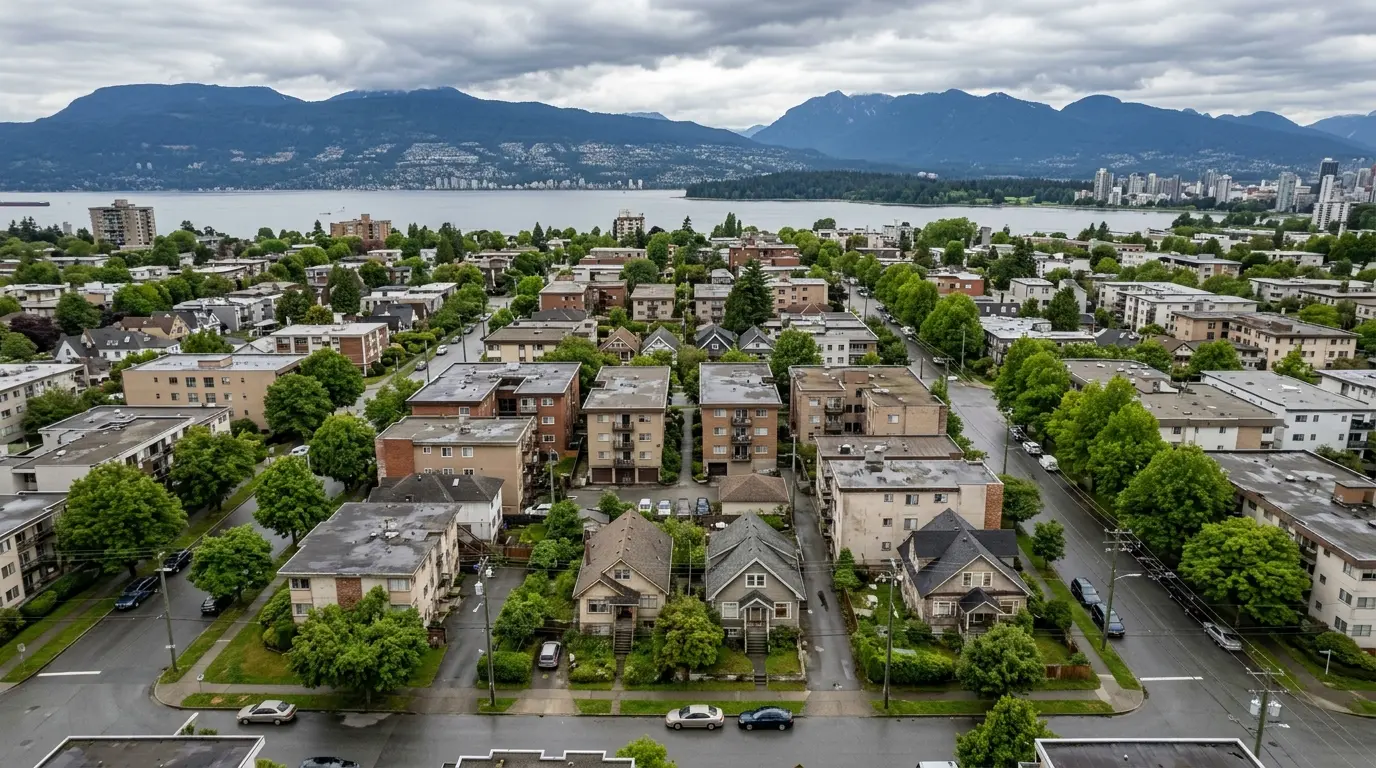
Vancouver’s city-wide plan is expanding higher-density zoning to arterial roads and village centres across the city. Streets that were traditionally single-family are being earmarked for 4-6 storey residential and mixed-use buildings. Fraser Street, Knight Street, 41st Avenue, Hastings Street east of Boundary — these corridors are all seeing increased developer interest for assembly.
The city-wide plan is still being phased in, which creates a window of opportunity. Developers who can assemble sites now, before the full rezoning is formalized, are positioning themselves for projects that will take 3-5 years to build. That means they’re buying today.
How the Assembly Process Works
Step 1: Developer Identifies a Target Block
It usually starts with a developer or their broker walking a neighbourhood, looking at lot configurations. They want sites where three, four, or five adjacent lots can be combined into a parcel that works for a specific building type. Corner lots, lots with lane access, lots near transit stations — these get flagged first.
Step 2: Initial Approach
The developer (or their agent) contacts homeowners one by one. Sometimes it’s a knock on the door. Sometimes it’s a letter. Sometimes it’s a phone call from a realtor you’ve never heard of.
This initial contact is usually vague on purpose. They want to gauge your interest before committing to a specific number. They might say something like, “We’re exploring development opportunities in your area and wondering if you’d consider selling.”
Be polite, but don’t commit to anything. And don’t throw out a number. The first person to name a price in an assembly negotiation is usually the person who leaves money on the table.
Step 3: Coordinated Negotiations
Once the developer has spoken with all the target homeowners, they’ll make offers — either individually or through a coordinated process. In a well-run assembly, all homeowners are represented by the same broker or realtor, which keeps everyone aligned and prevents the developer from playing neighbours against each other.
Pricing is typically based on lot size. If your lot is 4,000 square feet and your neighbour’s is 6,000, the neighbour gets paid more in proportion — roughly 50% more in this case. The per-square-foot rate should be the same for everyone.
Step 4: Due Diligence and Conditions
Once all parties have agreed on price, the developer enters a due diligence period — usually 60 to 120 days. During this time, they’re running detailed feasibility studies, getting preliminary architectural drawings done, confirming the site can support their intended project, and arranging financing.
All purchase agreements in the assembly are typically conditional on the developer successfully acquiring every lot. If one owner backs out, the whole deal can collapse — unless the developer has designed their project to work without that parcel.
Step 5: Closing
Closings are coordinated so all properties transfer simultaneously. This protects both sides: the developer doesn’t get stuck owning three of five lots with no way to build, and homeowners don’t sell while their neighbour holds out for more.
The entire process from first contact to closing typically takes 12 to 24 months.
Key Assembly Corridors in 2026
Not every Vancouver street is an assembly target. Developers focus on areas where rezoning (existing or anticipated) supports the kind of density that justifies the premium they’re paying. Here’s where I’m seeing the most activity right now.
Cambie Corridor
The Cambie Corridor has been an assembly hotspot since the Canada Line opened, but activity has intensified. Lots within two blocks of Cambie Street between Marine Drive and King Edward are commanding $350-$500+ per buildable square foot. Assemblies of three to five lots are trading for $8-15 million as sites for 6-storey wood-frame or concrete podium buildings.
Broadway Corridor (Clark to Vine)
The Broadway Plan area is where the biggest premiums are. Homeowners within 400 metres of the new Millennium Line stations at Mount Pleasant, Broadway-City Hall, Oak-VHB, South Granville, and Arbutus are being approached regularly. Assembly prices near station sites can reach $500-$700+ per buildable square foot, depending on the allowable density.
If you own a house within three blocks of any of these stations, you’ve probably already been contacted. If you haven’t, you will be.
Fraser Street
Fraser from Kingsway down to 49th is emerging as a major assembly target. The city-wide plan designates much of Fraser for increased density, and the relatively lower land values compared to west-side corridors make the economics attractive for developers. Assemblies here are trading at $250-$400 per buildable square foot — lower than Cambie or Broadway, but the gap is narrowing.
Arterial Routes: Knight, Victoria, Hastings East
These streets are earlier in the cycle. Developers are approaching homeowners but many assemblies are still in the speculative phase — contingent on formal rezoning that hasn’t been finalized yet. Prices are lower ($200-$350 per buildable square foot), but owners on these streets should pay attention. Once rezoning is confirmed, assembly activity will accelerate and early sellers typically get better terms.
41st Avenue Corridor
The area around the future UBC SkyTrain extension (expected to open around 2030-2032) is generating speculative assembly interest, particularly between Dunbar and Cambie. This is a longer-term play, and prices reflect the uncertainty. But if you own property along this corridor, it’s worth understanding what the extension could mean for your land value.
The Price Premium: What Assembly Adds
On average, homeowners who participate in a successful land assembly in Vancouver receive 20-40% more than they would selling their property individually to a residential buyer or even to a small-scale multiplex developer.
Here’s a simplified example:
| Scenario | Single Lot Sale | Assembly (per lot) |
|---|---|---|
| Lot size | 4,000 sq ft | 4,000 sq ft (x4 lots = 16,000 sq ft site) |
| Buyer type | Multiplex builder | Mid-rise developer |
| Allowable density | 1.0 FSR | 3.0+ FSR |
| Price | ~$2.0M | ~$2.6-2.8M |
| Premium | — | +30-40% |
The premium exists because assembled land unlocks density that individual lots cannot. A single 4,000-square-foot lot at 1.0 FSR supports 4,000 square feet of building. Four assembled lots at 3.0 FSR support 48,000 square feet of building. The developer can build 12 times more sellable space, and they’re willing to pay more per lot to make that happen.
The exact premium depends on location, the allowable density under current or anticipated zoning, site conditions, and how competitive the assembly process is.
The Holdout Problem
This is the single biggest risk in any land assembly. One homeowner refuses to sell, or demands a price that breaks the project’s economics, and the whole deal unravels.
Why Holdouts Happen
- Emotional attachment. “I’ve lived here for 40 years and I’m not ready to leave.” That’s entirely fair, and no one should feel pressured to sell their home. But it does kill the assembly.
- Unrealistic price expectations. Some owners believe their lot is the “key” to the assembly and demand 50-100% more than the per-square-foot rate offered to neighbours. This rarely works.
- Mistrust. Homeowners who feel the process is opaque or that their neighbours got a better deal will hold out on principle.
- Poor timing. Maybe they need to stay another two years for the kids to finish school, or they’re waiting for a spouse to retire.
How to Avoid Being the Holdout (or Dealing With One)
Get independent advice early. Hire your own realtor to give you a market opinion before the developer makes an offer. If you know what your property is worth on its own, you can evaluate the assembly premium objectively.
Communicate with your neighbours. Assemblies work best when homeowners talk to each other openly about their expectations. When one neighbour secretly negotiates a side deal, trust breaks down fast.
Understand the developer’s alternative. If one lot drops out of a five-lot assembly, the developer might be able to redesign around it. Your property goes from being part of a premium package to being a leftover lot next to a construction site. That’s a weak negotiating position.
Be realistic about your leverage. Corner lots and end lots sometimes justify a small premium (5-10%) within an assembly. But demanding double the per-square-foot price because you think your lot is irreplaceable is a good way to get designed around.
Tax Implications You Need to Know
Selling as part of an assembly triggers the same tax rules as any property sale, but the numbers tend to be larger — which means the tax exposure is too.
Principal Residence Exemption
If the property has been your principal residence for every year you owned it, the entire capital gain may be exempt from tax. This applies regardless of whether you sell individually or as part of an assembly.
Two things to watch:
- If you designated another property as your principal residence for any year during ownership, you’ll have a partial exemption and partial taxable gain
- You must report the sale on your tax return even if the full exemption applies
Capital Gains on Non-Exempt Sales
For investment properties, rental properties, or properties with only partial principal residence exemption, the capital gain is taxable. Since assembly premiums can push sale prices well above what you paid, the capital gain can be significant.
The federal government proposed raising the inclusion rate on gains above $250,000 a year from 50% to 66.67%, but cancelled that increase on March 21, 2025. As of now, all capital gains, at any amount, are included at 50% for individuals. On a $1.5 million gain, that’s $750,000 of taxable income. At a combined federal and provincial marginal rate around 50%, that’s roughly $375,000 in tax. Confirm the current inclusion rate with your accountant before closing, since this is a rule the federal government has proposed changing before.
Plan for this. Get your accountant involved before you sign anything. There may be ways to optimize timing or structure the transaction to reduce the hit.
The Flipping Tax
BC’s home flipping tax applies to properties sold within two years of purchase (as of the rules in effect since 2025). If you bought recently with the intent to flip into an assembly, be aware that profits could be taxed as income at your full marginal rate, not as capital gains. The exemption for life events (job relocation, divorce, serious illness) may apply, but speculative purchases don’t qualify.
GST Considerations
Selling your used residential property to a developer generally doesn’t trigger GST for you as the seller. However, developers will include GST-related clauses in their purchase contracts. Have your lawyer review these carefully — you don’t want to accidentally assume a GST liability that belongs to the developer.
How to Know If Your Property Is an Assembly Candidate
Not every property is suited for assembly. Here’s how to make a quick assessment.
You’re probably an assembly candidate if:
- Your property fronts a street identified in the Broadway Plan, the city-wide plan, or an existing corridor plan (Cambie, Marpole, etc.)
- You’re within 400 metres of a current or planned rapid transit station
- Your street is an arterial or a major collector road
- Your lot is adjacent to other similar-sized lots with older homes
- Developers have already been active on your block or nearby blocks
You’re probably not an assembly candidate if:
- Your property is in the interior of a single-family neighbourhood, away from arterials and transit
- The surrounding zoning only supports multiplex density (1.0 FSR), which doesn’t require assembly
- Your lot is oddly shaped or has access issues that would complicate a larger site plan
- There are heritage-designated homes on adjacent lots that can’t be demolished
If you’re unsure, the simplest test is to check Vancouver’s zoning maps for your address. Look at what density is currently allowed and what the city-wide plan proposes. If higher density is coming, assembly interest will follow.
Why Your Choice of Realtor Matters in an Assembly
Selling into a land assembly is fundamentally different from selling a house. The buyers are developers and investment groups with professional acquisition teams. The contracts are more complex. The timelines are longer. The negotiations have more moving parts.
I’ve represented homeowners on both sides of this — owners who were well-advised and captured every dollar of premium, and owners who accepted the first letter that came in the mail and left six figures on the table.
The biggest mistake I see: homeowners who get approached by a developer’s agent and assume that person is looking out for them. The developer’s agent works for the developer. They’re trying to acquire your property for the lowest possible price. That’s their job.
You need someone on your side who understands how developers value land, knows the current market for assembled sites, and has relationships with multiple developers who can create competition for your property.
If your property also qualifies for individual multiplex development, you need to understand both options — sell into an assembly or sell to a multiplex builder individually — so you can choose whichever delivers the best outcome.
Frequently Asked Questions
How do I know if a developer’s offer is fair?
Start with what your property is worth on the open market as a single-family or multiplex-development lot. That’s your baseline. A fair assembly offer should be 20-40% above that baseline, depending on location and the density the assembled site unlocks. If a developer offers you less than individual market value, or only marginally more, they’re banking on you not knowing what you have. Get an independent opinion from a realtor who handles development site sales before responding to any offer.
What happens if one neighbour refuses to sell?
It depends on which lot they own and how flexible the developer’s site plan is. Sometimes the developer can redesign the project to exclude one lot — the holdout keeps their house, and everyone else proceeds. But in many cases, especially with smaller assemblies, losing one lot kills the deal. If you’re part of an assembly and worried about a holdout, talk to your neighbours early. Understanding everyone’s timeline and expectations up front prevents surprises at the worst possible moment.
Can the developer force me to sell through expropriation?
No. Private developers have no expropriation power. Only government entities can expropriate property, and even then only for public purposes (roads, utilities, transit infrastructure). A developer cannot force you to sell, period. If you don’t want to participate in an assembly, that’s your right.
Should I wait for the rezoning to be finalized before selling?
It depends on your risk tolerance. Selling before formal rezoning means the developer is taking on regulatory risk, and they’ll reflect that in a lower price. Selling after rezoning confirmation typically gets you a higher price, but it also means more competition from other sellers and potentially a longer hold. Developers who buy early are willing to pay less but move faster. There’s no universal right answer — it depends on your financial situation, your timeline, and how confident you are that the rezoning will go through as planned.
What Comes Next
If you think your property might be an assembly candidate, the worst thing you can do is nothing. Developers move quickly. Neighbours make decisions without telling you. By the time someone knocks on your door with an offer, the terms may already be set.
The best thing you can do is get ahead of it: understand what your land is worth, talk to your neighbours, and get professional advice before you’re negotiating against a developer’s acquisition team.
I work with homeowners across Vancouver who are navigating assembly opportunities, multiplex sales, and development-driven transactions. If you want a straight answer about what your property is worth and whether an assembly makes sense for your situation, give me a call.
Greyden Douglas — (604) 218-2289 | Book a call | Get in touch
Sources
- Canada Revenue Agency — Update on the capital gains inclusion rate · government · accessed 2026-05-20
- Government of Canada — Cancellation of the proposed capital gains inclusion rate increase · government · accessed 2026-05-20
- Province of British Columbia — BC Home Flipping Tax · government · accessed 2026-05-20
Related Vancouver real estate pages
Continue with local service pages, neighbourhood guides, and actionable resources related to this topic.