Quick answer: OSFI's 2026 Capital Adequacy Requirements introduce the IPRRE classification for investor mortgages where rental income exceeds 50% of qualifying income, carrying 45% risk weights versus 30% for owner-occupied. Banks can no longer double-count income across multiple mortgage applications. The stress test remains at 5.25% or contract rate plus 2%.
OSFI's new IPRRE classification changes how banks treat investor mortgages starting in 2026. Here's what the double-counting ban, higher capital requirements, and risk weight changes mean for Vancouver landlords and multiplex investors.
Want a free assessment for your property?
Leave your name and phone — Greyden will call you back with a personalized market snapshot. No spam, no drip campaigns.
Join 1,000+ Vancouver homeowners. No spam, unsubscribe anytime.
I’ve had five conversations in the last two weeks with investor clients who are confused about the same thing: OSFI’s new mortgage rules for rental properties. One client with three rental condos in Mount Pleasant thought he couldn’t use rental income at all anymore. Another was convinced the stress test had been eliminated. Neither was right.
So let me walk through what actually changed on January 1, 2026, what it means if you own or plan to buy rental property in Vancouver, and where I think the real opportunities are for investors who adapt.
What Changed on January 1, 2026
OSFI (the Office of the Superintendent of Financial Institutions) released its final Capital Adequacy Requirements (CAR) Guideline for 2026 on September 11, 2025. The changes took effect at the start of this year.
The headline is a classification called IPRRE: Income-Producing Residential Real Estate. When a mortgage’s repayment depends materially on cash flows from the property itself (i.e., rental income), it gets classified as IPRRE instead of General Residential Real Estate (GRRE).
Why does classification matter? Because IPRRE loans carry higher risk weights for banks. According to Better Dwelling’s analysis of the CAR framework, a standard owner-occupied mortgage at 60-80% loan-to-value carries a 30% risk weight. An investor mortgage at the same LTV? 45%. That’s a 50% increase in the capital a bank needs to hold against that loan.
Banks don’t absorb that cost silently. They pass it forward.
The 50% Income Test
OSFI’s clarification page spells it out: if more than half of the qualifying income for a mortgage comes from the property’s own rental income, it gets flagged as IPRRE. Banks can also apply their own internal standards, as long as they’re at least as conservative as the 50% test.
For a Vancouver condo renting at $2,800/month, with an owner earning $120,000 annually, the rental income is roughly 22% of total qualifying income. That probably stays classified as GRRE. But a secondary investment property where the owner relies heavily on rent to qualify? That’s the target.
The “Double-Counting” Ban: What It Means in Practice
This is the part that confuses people most.
Mark Joshua, OSFI’s Director of Capital and Liquidity Standards, put it plainly in his September 2025 explanation to Canadian Mortgage Trends: the goal is “to ensure that income that’s used for one mortgage is not, then again, used a second time for another one.”
Here’s what that looks like in practice. Say you earn $150,000 from your job and you used that income plus $2,000/month in rental income from Property A to qualify for your mortgage on Property B. When you apply for Property C, you can’t count that same $150,000 or that same $2,000 again. As Valery.ca explains in their breakdown, “If Property A generates $2,000 in monthly rent, that income can be used to qualify for a mortgage on Property B. But when applying for Property C, the same $2,000 cannot be used again.”
Each new property needs its own verifiable income source.
What This Doesn’t Change
And here’s the part that matters just as much: your ability to use rental income for qualification hasn’t been eliminated.
OSFI was explicit about this: the CAR clarification “does not alter Guideline B-20 requirements to qualify borrowers for mortgages, including rental properties.” Financial institutions can continue applying rental income to underwrite mortgage applications.
The rules changed how banks classify loans for their own capital calculations. They did not change the underwriting rules that determine whether you qualify.
That distinction matters more than most commentary acknowledges.
Higher Capital Requirements Mean Higher Costs
When a bank classifies your investment mortgage as IPRRE, it needs to hold more capital in reserve. That makes the loan more expensive for the bank, and banks are not in the business of eating costs.
Mortgage Sandbox estimates that an investor with a $500,000 mortgage facing an additional 0.5% rate premium would pay roughly $200 more per month. That’s a meaningful hit on a property already running thin margins.
The magnitude of the actual rate premium is still settling. Different lenders are pricing this differently, and some are being more aggressive than others. But the direction is clear: investor mortgages will cost more than equivalent owner-occupied loans. How much more depends on the lender, the borrower’s profile, and the property’s income characteristics.
The 0.5% rate premium is an illustrative estimate from Mortgage Sandbox. Actual premiums vary by lender and borrower. Consult your mortgage broker for current investor rates.
Impact on Vancouver Landlords with Multiple Properties
This is where things get practical. If you own one rental property and your employment income comfortably supports both your primary residence mortgage and your rental mortgage, you’re probably fine. The IPRRE classification may apply to your investment property, but the rate premium may be modest.
If you own two, three, or more rental properties, the math changes fast.
The double-counting ban means you can’t recycle the same income across multiple applications. Each property needs to stand on its own, or you need new income sources to support each subsequent acquisition. For investors who built portfolios by leveraging employment income across multiple purchases, that strategy is effectively over.
I’m seeing this play out with clients right now. A couple in Kitsilano who own their home plus two rental condos wanted to buy a third. Under the old approach, they would have used their combined income and existing rental cash flows to qualify. Now, their broker is telling them the third property needs to demonstrate standalone cash flow, or they need additional employment income from somewhere.
Who Gets Hit Hardest
In my experience, the investors most affected are:
- Portfolio builders who used employment income as the backbone for qualifying across 3+ properties
- Negative cash flow investors who relied on appreciation and tax benefits rather than rental income to justify acquisitions
- Pre-sale flippers who intended to hold and rent out units, counting on future rental income to qualify for additional purchases
The investors least affected? People who buy properties that actually generate enough rent to service the debt independently. In Vancouver, that has always been hard to find. But it’s about to become the only game that works at scale.
How This Intersects with Multiplex Development
Here’s where I think the conversation gets interesting for Rain City’s audience.
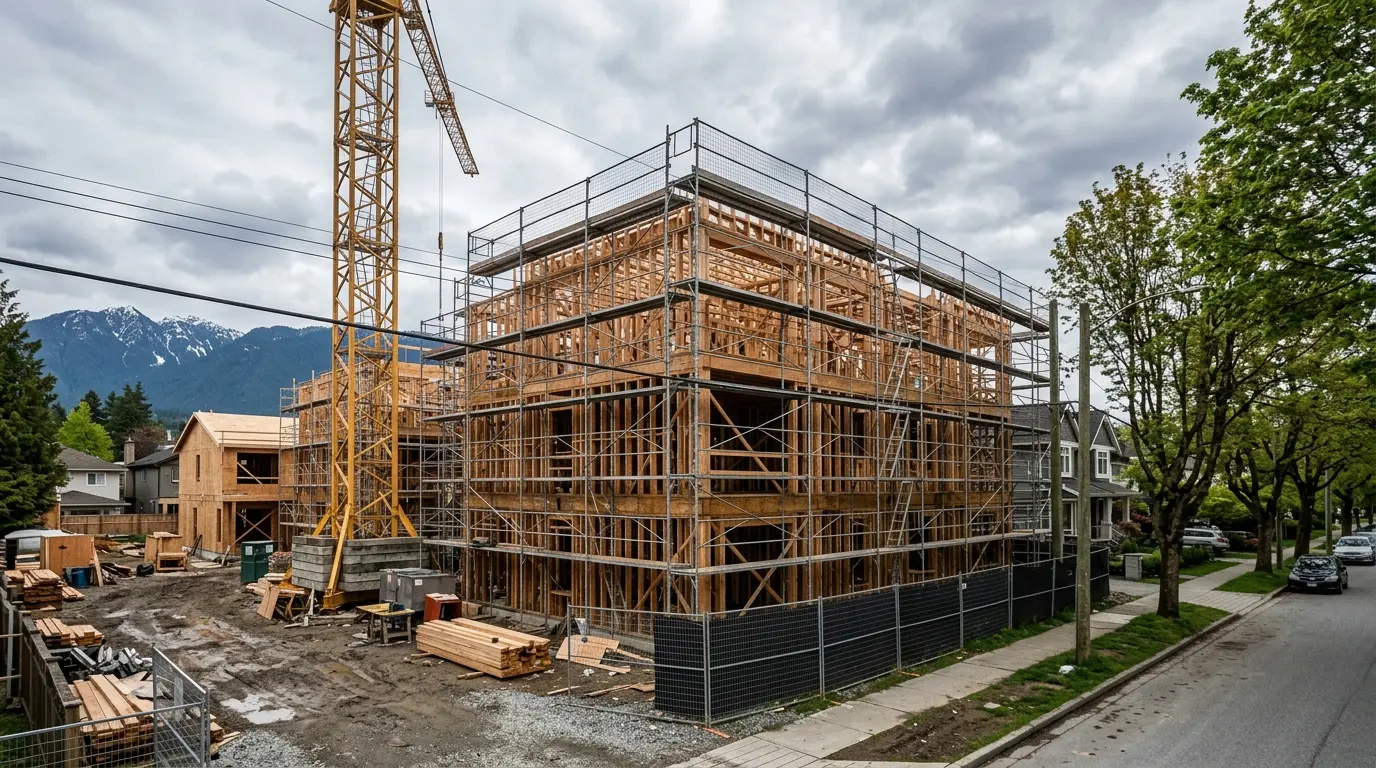
OSFI’s rules make it harder to scale a portfolio of individual condo rentals. But multiplex development under Bill 44 operates on different economics. When you convert a single-family lot into a 4-6 unit multiplex, the total rental income from the completed project is significantly higher than what a single unit produces.
A well-designed multiplex on a standard Vancouver lot can generate $10,000-$14,000/month in total rental income across all units. That level of cash flow can comfortably support the financing on its own, without relying on recycled employment income from other properties.
In other words, the OSFI rules actually reward the kind of development that Vancouver’s multiplex zoning was designed to encourage. Concentrated, income-producing properties that make financial sense on their own merits.
If you’re an investor thinking about where to deploy capital in this new regulatory environment, I’d argue that building or buying a multiplex is a stronger play than assembling a scattered portfolio of condos. The financing path is cleaner, the rental income is concentrated, and the property qualifies on its own terms.
For a deeper look at the numbers, see our Vancouver multiplex investment guide.
Strategies for Investors Adapting to the New Rules
After talking with mortgage brokers and investor clients over the past few months, here are the approaches that seem to be working.
Focus on Cash-Flowing Properties
This sounds obvious, but it represents a genuine shift for Vancouver. For years, investors here accepted negative cash flow because appreciation was the real play. That bet still exists, but financing it just got harder. Properties that can service their own debt from rental income will qualify more easily and attract better rates.
Consider Alternative Lending
Credit unions and private lenders aren’t regulated by OSFI in the same way as the big banks. Sunlite Mortgage notes that alternative lenders may charge 1-3% premiums above standard rates, but they may offer more flexible qualification criteria for investors with complex portfolios.
The tradeoff is real: higher rates, but access. For some investors, that math still works.
Look at Vendor Take-Back Mortgages
In situations where the seller is motivated, a vendor take-back (VTB) mortgage can bridge the gap between what a bank will lend and what the purchase price requires. This isn’t new, but it’s becoming more relevant as bank lending tightens for investor properties.
Consolidate and Improve Existing Holdings
Rather than buying more units, some investors are better served by improving the cash flow on properties they already own. Suite additions, renovations that justify rent increases, or converting to short-term rental where zoning allows it. If your existing portfolio generates stronger income per unit, your next acquisition becomes easier to finance.
Partner or Structure Creatively
Joint ventures, co-ownership structures, and holding companies each bring different income streams to the table. If you and a partner each bring separate employment income, the double-counting restriction is less of a barrier. Talk to your accountant and mortgage broker about the structure that works for your situation.
The Stress Test: What’s Actually Happening
There’s been a lot of noise about whether OSFI would eliminate the mortgage stress test in 2026. Short answer: it didn’t.
On January 29, 2026, OSFI left the stress test unchanged. The minimum qualifying rate remains the higher of 5.25% or your contract rate plus 2 percentage points. In a February 2026 fireside chat with Mortgage Professionals Canada, OSFI Superintendent Peter Routledge said that federally regulated lenders haven’t even asked for it to be removed: “They like it because it lowers their costs and removes competitive rivalry in lending standards.”
OSFI did make one notable change in late 2024: borrowers with uninsured mortgages can now switch lenders at renewal without retaking the stress test, as long as the loan amount and amortization stay the same. That’s helpful for renewal shoppers, but it doesn’t change anything for new purchases.
The LTI (loan-to-income) framework was also made permanent, capping how much high-leverage lending banks can do at a portfolio level. The threshold sits at 4.5 times income, but Routledge noted it’s not currently binding, with high-LTI mortgages representing only 16-18% of portfolios versus limits in the 15-25% range.
With the Bank of Canada’s overnight rate at 2.25% since January 28, 2026, and the next rate announcement scheduled for March 18, most borrowers are qualifying at the 5.25% floor anyway.
Key Takeaways
- OSFI’s IPRRE classification assigns 45% risk weights to investor mortgages versus 30% for owner-occupied, making investor loans more expensive for banks to hold and more expensive for you to carry
- The double-counting ban means each property in your portfolio needs its own income justification, ending the strategy of recycling employment income across multiple acquisitions
- B-20 underwriting rules are unchanged: you can still use rental income to qualify for mortgages, but that income can only be used once
- The stress test remains at 5.25% or contract rate plus 2%, with no changes planned
- Multiplex development may benefit from these rules because concentrated rental income from 4-6 units can independently support financing without income recycling
Frequently Asked Questions
Can I still use rental income to qualify for an investment property mortgage in 2026?
Yes. OSFI’s clarification explicitly states that financial institutions can continue using rental income to underwrite mortgage applications under Guideline B-20. What changed is how banks classify loans for capital purposes on their end. You can use rental income for qualification, but that same income cannot be counted again for a subsequent property.
How much more will investor mortgage rates increase because of IPRRE?
The exact premium varies by lender and borrower profile. Mortgage Sandbox estimates an additional 0.5% on investment property rates, which translates to roughly $200/month more on a $500,000 mortgage. Some lenders may price higher, others lower. Shop around and work with a broker who specializes in investor financing.
Does the OSFI IPRRE rule apply to my existing investment properties?
The classification applies to how banks hold capital against loans. If your existing mortgage is up for renewal, your lender may reclassify it under the new framework. This could affect renewal rates. The rule doesn’t retroactively change your current mortgage terms, but it may influence what you’re offered at renewal.
Is the mortgage stress test being eliminated in 2026?
No. OSFI left the stress test unchanged as of January 29, 2026. Superintendent Peter Routledge confirmed that lenders have not asked for its removal. The minimum qualifying rate remains at 5.25% or your contract rate plus 2%, whichever is higher.
How do these rules affect multiplex development financing?
Multiplex projects that generate concentrated rental income from multiple units can often qualify based on property cash flow alone, reducing reliance on the borrower’s employment income. This makes multiplex development relatively more attractive compared to assembling a portfolio of individual condo rentals, where each unit needs separate income justification under the new rules.
Sources
- OSFI - Clarifying guidance on rental income and mortgage classification
- OSFI - Backgrounder: Final Capital Adequacy Requirements Guideline 2026
- Canadian Mortgage Trends - OSFI clarifies capital treatment of IPRRE, September 2025
- Canadian Mortgage Trends - OSFI leaves mortgage stress test in place, January 2026
- Canadian Mortgage Trends - OSFI boss says lenders want stress test kept, February 2026
- Better Dwelling - Canadian investor mortgage crackdown set for 2026, delayed 3 years
- Mortgage Sandbox - Rental mortgage rule changes could trigger major shift
- Valery.ca - OSFI rental property mortgage guidelines 2026
- Bank of Canada - Policy rate held at 2.25%, January 28, 2026
Data sourced March 2026. Mortgage regulations and rates change frequently. Verify current figures with your mortgage broker before making financing decisions.
Next Steps: Work with Rain City Properties
If you’re an investor trying to figure out how OSFI’s new rules affect your portfolio or your next acquisition, I get it. The landscape shifted, and the old playbook needs updating. Whether you’re looking at multiplex development, repositioning existing holdings, or evaluating whether to buy in neighbourhoods like Kitsilano or Mount Pleasant, I can help you think through the strategy.
I’ve been working with Vancouver investors and builders for 20 years. The financing side of real estate has always been half the battle, and right now it matters more than usual.
Contact Greyden Douglas directly at (604) 218-2289 or book a call to discuss your Vancouver real estate goals.
Related Vancouver real estate pages
Continue with local service pages, neighbourhood guides, and actionable resources related to this topic.