Quick answer: Analysis of whether 2026 is a good time to invest in Vancouver real estate, examining benchmark prices (down 6-9% YoY), interest rates (BoC at 2.25%), rental vacancy rates (3.7%), inventory levels (37% above 10-year average), and risks including US tariffs and immigration slowdowns.
Vancouver prices are down 6-9% year-over-year, inventory is at a decade high, and interest rates have stabilized. Here's what the numbers actually say about investing in 2026.
Want a free assessment for your property?
Leave your name and phone — Greyden will call you back with a personalized market snapshot. No spam, no drip campaigns.
Join 1,000+ Vancouver homeowners. No spam, unsubscribe anytime.
I get asked this question more than any other right now. Clients call, they’ve been watching prices slide for a year, they’ve read the headlines about tariffs and recessions, and they want a straight answer: should I buy?
Here’s the honest version. The data in March 2026 paints a genuinely mixed picture. Prices are down. Inventory is up. Rates have come down a lot from their peak. But there’s real economic uncertainty — tariffs, slowing immigration, a potential recession — that could push things either direction. I’ll walk through every major data point so you can make your own call.
Where Prices Stand Right Now
According to Greater Vancouver Realtors’ February 2026 report, benchmark prices have dropped meaningfully across all property types:
| Property Type | Benchmark Price (Feb 2026) | Year-over-Year Change | Month-over-Month |
|---|---|---|---|
| Composite (all types) | $1,100,300 | -6.8% | -0.1% |
| Detached homes | $1,835,900 | -8.8% | -0.8% |
| Townhouses | $1,046,100 | -5.6% | +0.3% |
| Condos/apartments | $708,200 | -6.8% | +0.5% |
Source: GVR February 2026 Monthly Statistics
Those are real declines. Detached homes are down nearly 9% from a year ago. If you’d been trying to buy in early 2025, you’re looking at properties that are $150,000-$180,000 cheaper today on the benchmark.
But here’s the thing — condos and townhouses actually ticked up month-over-month in February. Tiny moves, half a percent or so, but worth noting. The floor might be forming in the attached market while detached homes continue to drift lower.
The Buyer’s Market Question
Is it actually a buyer’s market? Let’s look at the numbers that matter.
February 2026 saw 1,648 sales across Metro Vancouver — down 9.8% from February 2025 and a full 28.7% below the 10-year seasonal average. Meanwhile, active listings hit 13,545 properties, up 6.3% year-over-year and 37% above the 10-year average.
The sales-to-active listings ratio sits at 12.6% overall. For context, prices tend to face downward pressure when this ratio stays below 12%, and upward pressure above 20%. We’re barely above the threshold — and for detached homes specifically, the ratio is just 9%. That’s firmly in buyer’s market territory.
What does that mean in practice? Negotiating power. I’m seeing offers accepted 5-8% below asking on detached properties, and sellers who listed in January are doing price reductions by March. If you’ve been waiting for leverage, you have it right now.
Interest Rates: The Tailwind That Already Happened
The Bank of Canada held its overnight rate at 2.25% on January 28, 2026, after six consecutive cuts since June 2024. The next decision is scheduled for March 18, 2026.
Most analysts expect the BoC to hold at 2.25% through much of 2026. Inflation is near the 2% target, but the economy is growing slowly — the Bank’s own forecast projects just 1.1% GDP growth in 2026.
Here’s what matters for investors: fixed mortgage rates have already priced in much of the easing. You’re not going to get dramatically cheaper money from here. The rate cuts that brought us from 5% down to the low-4% range on fixed rates — that’s the gift. It’s already in your pocket. The question is whether you use it.
A rough illustration of what current rates mean for investment purchases:
| Scenario | Purchase Price | Down Payment (20%) | Mortgage | Monthly Payment* |
|---|---|---|---|---|
| Condo | $710,000 | $142,000 | $568,000 | ~$3,060 |
| Townhouse | $1,050,000 | $210,000 | $840,000 | ~$4,530 |
| Detached | $1,840,000 | $368,000 | $1,472,000 | ~$7,935 |
Based on 4.5% fixed rate, 25-year amortization, 20% down. For illustration only — verify current rates with your mortgage broker.
The Rental Income Picture
This is where it gets interesting — and a bit complicated.
Vancouver’s rental vacancy rate doubled to 3.7% in 2025, the highest in more than 30 years according to CMHC. That sounds like bad news for landlords, and for some segments it is. New-build condos near transit and purpose-built rentals in the suburbs are competing for tenants in ways they haven’t had to in years.
But average asking rents tell a different story. A one-bedroom in Vancouver proper still averages around $2,376 per month, and two-bedrooms average $3,289. In February 2026, rents actually ticked up 1.3% month-over-month.
So vacancies are up but rents aren’t really falling? That’s the paradox. The vacancy increase has been concentrated in newer, pricier units — particularly in suburban locations. Well-located older stock in established neighbourhoods still rents quickly. If you’re buying a condo in Kitsilano or Mount Pleasant, the rental math is very different from a new build in South Surrey.
Rental Yield by Property Type
Let me run the rough numbers on gross rental yields at current prices and rents:
| Property Type | Benchmark Price | Estimated Monthly Rent | Gross Yield |
|---|---|---|---|
| Condo (1BR, central) | $708,200 | $2,376 | 4.0% |
| Condo (2BR, central) | $850,000 | $3,289 | 4.6% |
| Townhouse | $1,046,100 | $3,800 | 4.4% |
| Detached (as rental) | $1,835,900 | $4,200 | 2.7% |
Gross yields — does not account for property tax, insurance, maintenance, vacancy, or strata fees. Two-bedroom condo price estimated based on typical premium over benchmark. Rents from Zumper and DailyHive, February 2026.
A 4-4.6% gross yield on condos is actually decent by Vancouver standards. Net yields after expenses will be closer to 2.5-3.5%, which won’t impress someone from Calgary or Edmonton. But Vancouver has never been a pure cash-flow market. The play has always been appreciation plus modest yield — and right now you’re buying at prices that are 7-9% lower than a year ago.
The Risks: Tariffs, Immigration, and Recession
I’d be lying if I said there wasn’t genuine downside risk. Three things keep me up at night.
US Tariffs
This is the wildcard. The BC government has estimated that sustained US tariffs could cause a $69 billion economic loss by 2028 and 124,000 job losses. CMHC’s 2026 Housing Market Outlook explicitly flags a potential recession as a possibility if trade disruptions worsen.
If we enter a recession, prices could fall further — maybe another 5-10% — before recovering. Nobody has a reliable crystal ball for trade policy right now.
Slowing Immigration
Metro Vancouver’s population growth fell to just 0.2% in the year to July 2025, driven by a net loss of over 10,000 non-permanent residents. The federal government’s reduced immigration targets mean this slowdown will continue through 2026-2027.
Less population growth means less housing demand, period. This is particularly relevant for the condo market, which has historically depended on newcomer demand.
Condo Oversupply
CMHC notes that condominium presales have declined significantly, with projects being postponed or cancelled. That’s a mixed signal — fewer new starts mean less future supply, but the existing pipeline of units started in 2022-2023 is still delivering into a soft market.
The Bull Case: Why Some Investors Are Buying Right Now
Despite the risks, I’m seeing active investors make moves. Here’s their logic.
Prices Are Genuinely Discounted
We’ve established that benchmark prices are down 6-9%. BCREA’s Q1 2026 forecast projects BC’s average home price rising about 3% to $982,800 in 2026, with sales volume increasing 12% to 78,690 units. If that forecast plays out, buying at today’s lows looks smart in hindsight.
Affordability Has Improved Significantly
National Bank’s Housing Affordability Monitor shows Vancouver’s mortgage payment as a percentage of income (MPPI) dropped to 85% in Q4 2025 — down from a peak of 103.9% in late 2023. That’s still extremely expensive by national standards, but it’s the biggest improvement in affordability on record. Lower rates and lower prices are both contributing.
The Multiplex Opportunity
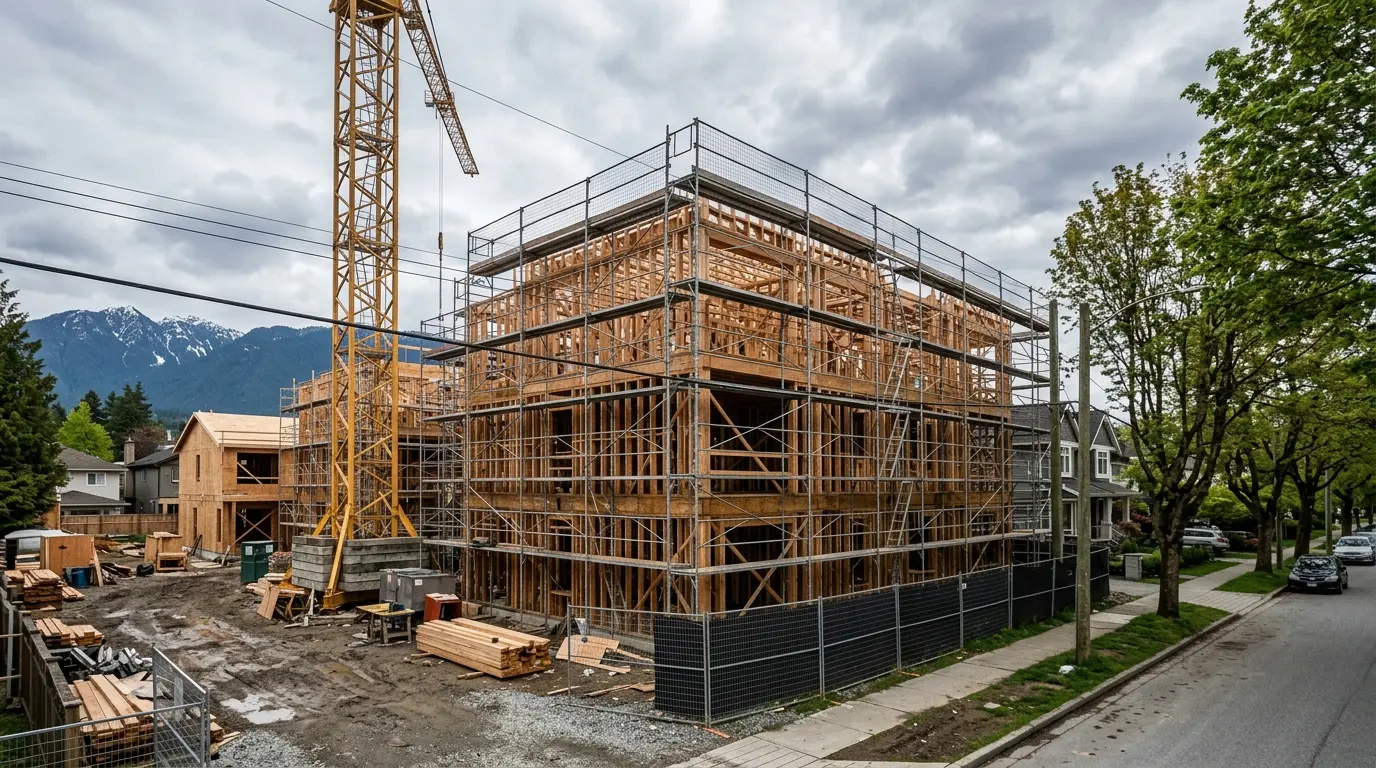
This is unique to Vancouver’s current moment. Bill 44 means single-family lots can now support 3-6 units. If you’re buying a detached property at a nearly 9% discount to last year, you’re also buying land that has significantly more development potential than it did three years ago. The investors I work with who are doing best right now are buying older homes on larger lots in Kitsilano, Mount Pleasant, or along the Cambie corridor — not for the house, but for the land and its multiplex potential.
Construction Costs Are a Constraint on Future Supply
US tariffs on building materials could raise construction costs by 10-15%, according to industry estimates. Higher costs mean fewer new homes get built, which constrains future supply. If you can buy existing stock at today’s prices, you’re effectively getting in below replacement cost in some segments.
My Honest Assessment: It Depends on Your Strategy
I don’t have a clean “yes buy now” or “no wait” answer. It genuinely depends on what you’re trying to do.
If you’re a long-term buy-and-hold investor (5+ year horizon): The math looks reasonable. You’re buying at real discounts, rates are manageable, and Vancouver’s fundamental supply constraints haven’t gone away. The city still has geographic limits (ocean, mountains, agricultural reserve), strong institutional demand, and a structural housing shortage that will reassert itself once immigration normalizes. I think you’ll look back at 2026 prices and feel okay about them.
If you’re looking for cash flow: Be very selective. Gross yields of 4-4.6% on condos are workable, but only if you buy well and manage costs. Avoid overpriced new builds and focus on well-located resale units where you have some value-add potential — a cosmetic renovation, a suite addition, or a below-market purchase through estate sales or motivated sellers.
If you’re a multiplex developer: This might be the best window you’ll get. Land prices are down, zoning has been permanently liberalized, and once the market recovers, lot prices will adjust upward to reflect the higher-density potential. The gap between what you can buy a lot for today and what it could produce as a 4-6 unit building is the widest I’ve seen.
If you’re speculating on short-term appreciation: I’d be cautious. The tariff situation creates real uncertainty, and short-term price movements are impossible to predict. The sales-to-active ratio suggests we’re not out of the correction yet, at least for detached homes.
Key Takeaways
- Vancouver benchmark prices are down 6-9% year-over-year across all property types, with detached homes seeing the steepest declines
- The sales-to-active listings ratio at 12.6% (9% for detached) indicates buyer-friendly conditions with real negotiating leverage
- Gross rental yields of 4-4.6% on condos are reasonable by Vancouver standards, though rising vacancies (3.7%) mean tenant selection matters more than before
- US tariffs, slowing immigration, and potential recession are genuine risks — but they’re also why prices are discounted in the first place
- Long-term investors and multiplex developers are likely better positioned than short-term speculators in this environment
Frequently Asked Questions
Will Vancouver real estate prices drop more in 2026?
Possibly. The detached market is still soft with a 9% sales-to-active ratio, and tariff uncertainty could push prices lower. BCREA forecasts a modest 3% average price increase provincewide, but that’s driven by composition shifts (more Lower Mainland sales), not necessarily rising values in every segment. Condos and townhouses appear to be stabilizing, while detached homes may have more room to fall.
What is a good cap rate for Vancouver investment property?
Vancouver cap rates for residential investment properties typically range from 3-5%, lower than most Canadian cities because investors are pricing in long-term appreciation. At current prices, well-located condos can achieve gross yields around 4-4.6%, with net yields closer to 2.5-3.5% after expenses. Multiplex developments can target higher returns — 6-8% or more — but require significant capital and development expertise.
How do US tariffs affect Vancouver real estate investment?
Tariffs create two opposing forces. On the demand side, economic uncertainty and potential job losses could weaken buyer demand and push prices lower. On the supply side, tariffs on US building materials (steel, aluminum, appliances) could raise construction costs 10-15%, reducing new supply. For existing property investors, the net effect is uncertain — but buying existing stock below replacement cost can be a hedge against construction cost inflation.
Is it better to invest in a Vancouver condo or detached home in 2026?
It depends on your strategy. Condos offer better rental yields (4-4.6% gross vs. 2.7% for detached) and lower entry costs. Detached homes offer deeper discounts right now (down 8.8% YoY) and multiplex development potential under Bill 44. For pure rental investment, condos make more financial sense. For development or long-term land appreciation, detached properties on larger lots have more upside.
Should I wait for interest rates to drop further before buying?
The BoC has already cut from 5% to 2.25% over six consecutive reductions. Most analysts expect rates to hold near current levels through 2026. Fixed mortgage rates have largely priced in the easing that’s already happened. Waiting for dramatically lower rates is a gamble — and if rates stay flat while prices recover, you could end up paying more for the same property.
Sources
- Greater Vancouver Realtors — February 2026 Monthly Statistics
- Bank of Canada — January 28, 2026 Rate Decision
- CMHC — Housing Market Outlook 2026
- BCREA — Q1 2026 Housing Forecast
- Statistics Canada — Subprovincial Population Estimates, January 2026
- National Bank — Housing Affordability Monitor
- CMHC — Metro Vancouver Vacancy Rate (via DailyHive)
- RE/MAX Canada — How Tariffs Impact Housing
Data sourced March 2026. Market conditions change frequently. Verify current figures before making financial decisions.
Next Steps: Work with Rain City Properties
If you’re weighing a Vancouver real estate investment, I’d rather have a 15-minute conversation than have you rely solely on a blog post — including this one. Every investor’s situation is different: your timeline, your risk tolerance, your capital, and your target neighbourhood all change the answer.
I’ve been working with investors in Vancouver for 20 years, and I have direct relationships with builders and developers across the West Side. Whether you’re looking at a rental condo, a multiplex development site, or a long-term hold, I can walk you through the specific numbers for the properties you’re considering.
Contact Greyden Douglas directly at (604) 218-2289 or book a call to discuss your Vancouver real estate goals.
Related resources: Vancouver Investment Guide · Multiplex Resource Hub · Presales Hub
Related Vancouver real estate pages
Continue with local service pages, neighbourhood guides, and actionable resources related to this topic.