Quick answer: Comprehensive relocation comparison between Toronto and Vancouver covering real estate prices, closing costs, cost of living, neighbourhood equivalents, and practical tips for buyers moving from the GTA to Metro Vancouver in 2026.
Thinking about moving from Toronto to Vancouver? Here's what your Toronto budget actually buys you here, what costs more (and less), and the neighbourhood equivalents to help you get oriented.
Want a free assessment for your property?
Leave your name and phone — Greyden will call you back with a personalized market snapshot. No spam, no drip campaigns.
Join 1,000+ Vancouver homeowners. No spam, unsubscribe anytime.
I get a call from a Toronto buyer at least twice a month. The conversation usually starts the same way: “We’re thinking about moving out west, and we have no idea where to start.” Then comes the real question — “Can we actually afford Vancouver?”
The honest answer in 2026: it depends on what you’re selling in Toronto, what you want to buy here, and whether you understand how differently the two markets work right now. Both cities are in correction territory. Both are down year-over-year. But the details matter, and they’re not what most people expect.
The Real Estate Price Comparison
Let’s start with the numbers side by side. Both markets have softened, but they’ve softened differently.
| Property Type | Vancouver (GVR March 2026) | Toronto (TRREB March 2026) |
|---|---|---|
| Composite benchmark | $1,104,300 (-6.8% YoY) | $941,800 (-7.4% YoY) |
| Detached average | $1,854,800 (-8.2% YoY) | $1,340,000 (-6.7% YoY) |
| Condo average | $706,700 (-7.8% YoY) | $620,000 (-9.0% YoY) |
| Townhouse average | $1,047,100 (-5.7% YoY) | $932,000 (-6.9% YoY) |
Sources: GVR March 2026 Report, TRREB March 2026 via Zoocasa
Vancouver is more expensive across the board, but the gap is smaller than it was in 2021-2022. Detached homes are where the biggest difference sits — about $500K more in Vancouver. Condos are closer: roughly $85K apart.
What Your Toronto Budget Gets You in Vancouver
This is what people actually want to know. If you’re selling in Toronto, here’s what the proceeds translate to in Vancouver.
Selling a semi in Leslieville (~$1.1M) → Buying in Mount Pleasant You’re looking at a 2-bedroom condo or a smaller townhome. Mount Pleasant has the same creative, independent-business energy that Leslieville has. Coffee shops, breweries, restaurants, young families mixed with professionals.
Selling a detached in North York (~$1.3M) → Buying in East Vancouver A detached home on the east side, possibly with a rental suite. East Van gives you the space and family-friendly feel of North York’s residential streets, plus you’re 15 minutes from downtown.
Selling a Harbourfront condo (~$650K) → Buying in Yaletown or the West End Very similar price point. Yaletown is the closest thing Vancouver has to King West — glass towers, restaurants, waterfront. The West End is denser and more community-oriented, closer to the Annex vibe.
Selling in Rosedale or Forest Hill (~$2.5M+) → Buying in Kitsilano or Kerrisdale Vancouver’s west side. Tree-lined streets, excellent schools, proximity to the beach. Kitsilano feels like the Beaches but with mountains instead of a lake.
Closing Costs: Ontario vs BC
This is where Toronto buyers get a surprise — sometimes a good one.
Property Transfer Tax Comparison
Toronto buyers pay double land transfer tax: Ontario’s provincial LTT plus Toronto’s Municipal LTT. Vancouver buyers pay BC’s Property Transfer Tax only (no municipal layer).
| BC PTT | Ontario LTT | Toronto MLTT (city buyers) | |
|---|---|---|---|
| First $55K | 1% | 0.5% | 0.5% |
| $55K–$250K | 1% | 1.0% | 1.0% |
| $250K–$400K | 1% | 1.5% | 1.5% |
| $400K–$2M | 2% | 2.0% | 2.0% |
| Over $2M | 3% | 2.5% | 2.5% |
Sources: BC Gov PTT, City of Toronto MLTT
Example on a $1.1M home:
- BC PTT: ~$18,000
- Ontario LTT alone: ~$16,475
- Ontario LTT + Toronto MLTT: ~$32,950
If you’re coming from the City of Toronto specifically, you’ll actually pay less in transfer tax in Vancouver. That catches people off guard.
First-time buyer exemptions also differ:
- BC: full PTT exemption on homes up to $835,000 (partial to $860,000)
- Ontario: rebate of up to $4,000 on provincial LTT
- Toronto: additional rebate of up to $4,475 on MLTT
Cost of Living Beyond Housing
Housing is the big number, but here’s how the rest of daily life compares.
What costs MORE in Vancouver:
- Car insurance — ICBC is a government monopoly. Expect $200-$350/month for standard coverage. This shocks Toronto buyers, where competitive rates can be $150-$250.
- Groceries — slightly higher, maybe 5-10%. The selection is similar.
- Childcare — comparable in cost, but waitlists can be longer in certain Vancouver neighbourhoods.
What costs LESS in Vancouver:
- Income tax — BC’s provincial tax brackets are lower than Ontario’s for most income levels. On $100K income, you’d save roughly $1,500-$2,000/year in BC.
- Transit — a monthly TransLink pass is $105-$185 depending on zones (3-zone covers all of Metro Vancouver). TTC is $156/month for Toronto only, but you need separate passes for GO Transit.
- Heating — Vancouver’s mild winters mean lower heating bills. You won’t need to run the furnace from November through March the way you do in Toronto.
What’s about the same:
- Restaurant and entertainment costs
- Internet and phone plans
- General retail
According to Numbeo’s city comparison data, consumer prices (excluding rent) are within 2-3% of each other. The difference is almost entirely in housing.
The Neighbourhood Translation Guide
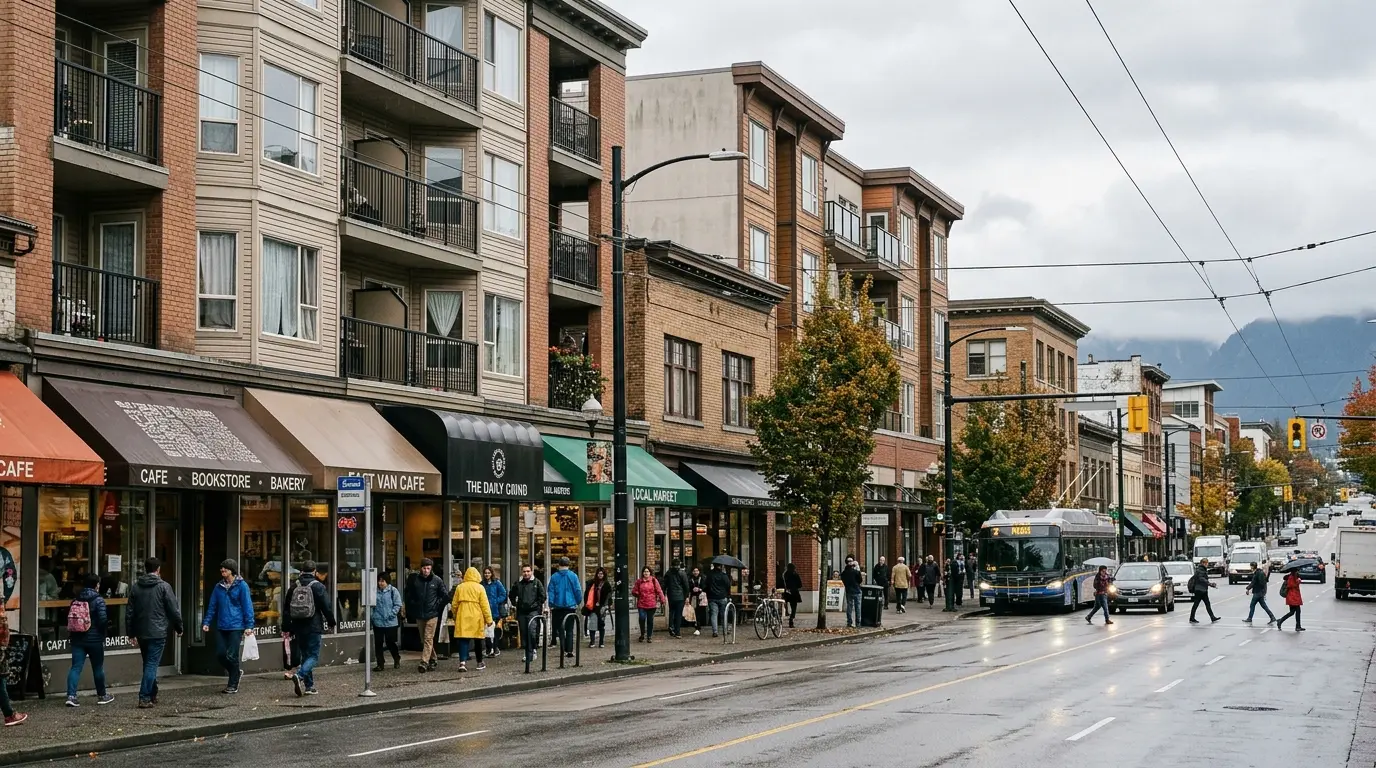
This is what I walk Toronto buyers through on our first call. Vancouver is much smaller geographically than the GTA, so everything is closer together. What takes 45 minutes by car in Toronto might be 15 minutes in Vancouver.
Kitsilano = The Beaches Beach access, yoga studios, young families, brunch culture. Slightly more expensive than the Beaches. The mountain views are a serious upgrade.
Mount Pleasant = Queen West / Leslieville Breweries, independent shops, artist studios, Main Street strip. The most “Toronto east-side” neighbourhood Vancouver has.
Yaletown = King West / Liberty Village Condo towers, restaurants, waterfront living. Former industrial area turned trendy. Younger crowd.
West End = The Annex Dense, walkable, diverse. Close to everything. Stanley Park is the neighbourhood’s backyard (imagine living next to High Park, but bigger and on the ocean).
Commercial Drive = Kensington Market Multicultural, bohemian, independent. Italian cafes, vintage shops, live music. More residential than Kensington but the same spirit.
Kerrisdale = Lawrence Park Established, leafy, excellent schools. Older demographic. Quiet and well-maintained. Higher price point.
Fairview = Summerhill / Rosedale (condo corridor) Granville Island access, South Granville shopping, transit-connected. A mix of condos and older homes.
The Lifestyle Difference (Honest Version)
I’m not going to oversell Vancouver. If you’re coming from Toronto, there are genuine trade-offs.
What you gain:
- Mountains and ocean access within 30 minutes of downtown. This never gets old, even after 20 years.
- Milder winters. It rains, but it rarely drops below freezing. No shovelling. No wind chill warnings.
- A more relaxed pace. Vancouver moves slower than Toronto. Whether that’s a pro or a con depends on your personality.
- Outdoor lifestyle year-round. Skiing in winter, hiking and beaches in summer, running and cycling whenever.
What you lose:
- Toronto’s cultural infrastructure. Vancouver has improved, but Toronto has more theatre, museums, live music venues, and sports teams.
- The diversity of dining at the very top end. Vancouver’s Asian food scene is world-class, but Toronto has more breadth across cuisines.
- Career networking density. Toronto’s financial district, legal community, and tech hub are still larger. If you need in-person face time for your career, think hard about this.
- Airport connections. Pearson has more direct international flights than YVR.
The rain. Yes, it rains a lot from November through March. It’s not dramatic rain — it’s persistent drizzle. You either learn to love it or you invest in good rain gear and complain about it like the rest of us.
The 2026 Buyer’s Market Advantage
Here’s the timing angle: both Toronto and Vancouver are in correction, but Vancouver’s buyer’s market is deeper. The sales-to-active ratio here is 14.2% as of March 2026, meaning inventory is high and competition is low.
For a relocating buyer, that means:
- More time to find the right home (no panic buying)
- Negotiation leverage you wouldn’t have had in 2021-2022
- The ability to keep all your subject clauses (financing, inspection, strata docs)
- Properties sitting for 50-100 days, giving you time to sell in Toronto first
If you time it well — sell in Toronto, rent short-term in Vancouver, take your time buying — you’re in a strong position.
Practical Relocation Tips
Based on what I’ve seen work (and not work) for Toronto buyers:
Visit before you commit. Spend a week in Vancouver, not as a tourist but as a potential resident. Walk the neighbourhoods. Ride transit. Check the commute. See what a Tuesday evening feels like, not just a Saturday afternoon.
Rent first if you can. Six months of renting in your target neighbourhood will teach you things that Zillow and Google Maps cannot. You’ll learn which blocks are noisy, which grocery stores are good, and whether you actually like the rain.
Get pre-approved with a BC lender. Your Toronto mortgage approval doesn’t automatically transfer. BC has different property transfer tax rules, and your new lender will need to assess the specific property you’re buying here.
Hire a local realtor. This isn’t a pitch — it’s practical advice. Vancouver’s micro-markets are extremely neighbourhood-specific. A block can make a $100K difference. You need someone who knows the streets, the buildings, and the history.
Key Takeaways
- Vancouver is 10-15% more expensive than Toronto for comparable housing, with the gap largest for detached homes
- Closing costs may actually be lower coming from Toronto (no double land transfer tax)
- Daily cost of living is within 2-3% — car insurance is the biggest non-housing surprise
- Both markets are in correction, but Vancouver’s deeper buyer’s market gives relocators better negotiating power
- Rent first if possible, and visit neighbourhoods on weekdays before committing
Frequently Asked Questions
Is Vancouver more expensive than Toronto for real estate?
Yes, but the gap has narrowed. As of March 2026, Vancouver’s composite benchmark is $1,104,300 vs Toronto’s $941,800 — about 17% higher. Condos are closer at $706,700 vs $620,000. The biggest gap is in detached homes: $1,854,800 in Vancouver vs $1,340,000 in Toronto.
Do I pay more in land transfer tax in Vancouver or Toronto?
If you’re buying in the City of Toronto, you actually pay more — Toronto charges both the Ontario provincial LTT and a municipal LTT. On a $1.1M home, you’d pay about $33K in Toronto vs $18K in Vancouver for BC’s PTT.
What Vancouver neighbourhood is most like Queen West in Toronto?
Mount Pleasant, centred on Main Street between Broadway and 33rd Avenue. It has the same independent-business, brewery-and-brunch energy. Commercial Drive is another option with more of a Kensington Market feel.
Should I sell my Toronto home before buying in Vancouver?
In the current buyer’s market, yes. Selling first gives you certainty on your budget, and Vancouver’s inventory is high enough that you won’t miss out. Consider renting in Vancouver for a few months while you search — it removes the pressure of timing both transactions simultaneously.
Sources
- Greater Vancouver Realtors — March 2026 Monthly Market Report
- TRREB March 2026 Statistics via Zoocasa
- City of Toronto — Municipal Land Transfer Tax Rates
- Numbeo — Cost of Living Comparison: Vancouver vs Toronto
Data sourced April 2026. Market conditions change frequently. Verify current figures before making financial decisions.
Thinking About the Move?
I help Toronto buyers navigate Vancouver’s market every month. The neighbourhoods, the pricing dynamics, the closing process — it’s all different enough that having someone who knows the local details makes a real difference. I’ll walk you through the numbers, show you the areas that match what you’re looking for, and help you avoid the mistakes I’ve seen other relocators make.
Contact Greyden Douglas directly at (604) 218-2289 or get in touch here to start planning your move.
Related resources: Moving to Vancouver Guide · Explore Vancouver Neighbourhoods · International Buyers Guide
Related Vancouver real estate pages
Continue with local service pages, neighbourhood guides, and actionable resources related to this topic.