Quick answer: Vancouver's east side and west side traditionally divide at Cambie Street, with the west commanding 30-50% higher prices per square foot historically. In 2026 the gap has narrowed in some segments — east-side multiplex inventory and Mount Pleasant-Commercial Drive demand have lifted east-side comparable prices, while west-side Cambie corridor and Kerrisdale remain premium. The right side depends on price tolerance, school catchment priorities, and commuting patterns.
The east-west price gap has been narrowing for a decade. In 2026's buyer's market, the gap matters more than ever — and the right side for you depends on three factors most agents won't acknowledge.
Want a free assessment for your property?
Leave your name and phone — Greyden will call you back with a personalized market snapshot. No spam, no drip campaigns.
Join 1,000+ Vancouver homeowners. No spam, unsubscribe anytime.
The east-west divide in Vancouver real estate has been the city’s defining geographic split since the 1920s. West of Cambie Street meant larger lots, older money, top-ranked schools, and views. East of Cambie meant working-class neighbourhoods, smaller lots, denser housing, and prices that made Vancouver feel briefly like a city you could afford.
In 2026 that divide is more nuanced than it’s ever been. The east side has gentrified in pockets. The west side has commoditized in others. Multiplex zoning is touching both sides simultaneously and reshaping density on streets that haven’t changed in 60 years. The price gap is real but narrower than the cultural shorthand suggests, and the right side for any specific buyer depends on three things that the surface-level “east is cheaper” narrative misses entirely.
Here’s the honest comparison in May 2026.
Where the Line Actually Is
The traditional divider is Cambie Street, running north-south from Stanley Park to the Fraser River. West of Cambie is “west side.” East of Cambie is “east side.”
But it’s not quite that clean:
- Mount Pleasant straddles the line and is split by realtors into Mount Pleasant West (VW) and Mount Pleasant East (VE)
- Marpole is technically west-of-Cambie but doesn’t carry the same premium as Kerrisdale or Kits — it’s more of a “west side value” zone
- Cambie Heights / South Cambie themselves are west side but the entire Cambie corridor functions as its own price zone
- Downtown, West End, Yaletown, and Coal Harbour are downtown-zone, not east-vs-west
For the purposes of this comparison, “west side” means: Kitsilano, Point Grey, West Point Grey, Dunbar, Kerrisdale, Shaughnessy, Arbutus, Quilchena, South Granville, Mount Pleasant West. “East side” means: Mount Pleasant East, Commercial Drive, Hastings-Sunrise, Renfrew, Killarney, Victoria-Fraserview, Sunset, Knight, Strathcona.
The 2026 Price Comparison
| Property type | West side typical | East side typical | Premium |
|---|---|---|---|
| 2BR condo (~900 sqft) | $850K–$1.05M | $580K–$780K | 35–45% |
| 3BR townhouse | $1.4M–$1.9M | $1.0M–$1.4M | 35–40% |
| Detached ~2,500 sqft | $2.4M–$3.5M | $1.4M–$2.0M | 60–80% |
| Standard 33×120 lot | $2.0M–$3.0M | $1.2M–$1.7M | 65–75% |
| New multiplex unit | $1.3M–$1.7M | $1.0M–$1.3M | 25–30% |
Approximate ranges based on April 2026 GVR market data and observed listing comps. Premium represents typical west-vs-east price differential. Individual neighbourhoods vary substantially.
The detached premium is the largest because the underlying land is the differentiator. The multiplex premium is the smallest because new construction equalizes some of the lot-value gap with newer, more efficient floor plans.
What Each Side Actually Gives You
West Side: What You Pay For
- School catchments. Lord Byng, University Hill Secondary, Sir Winston Churchill, Lord Tennyson Elementary are all west-side. For families prioritizing public school access without going private, this is the single largest reason west-side parents pay the premium.
- Beach and seawall access. Kits Beach, Locarno, Spanish Banks, Jericho — the west side beaches and the seawall are unmatched.
- UBC proximity. Faculty, staff, and many professionals working at UBC, Vancouver General, or downtown firms cluster on the west side for commute times.
- Heritage and character. Shaughnessy, West Point Grey, Kerrisdale carry architectural heritage that doesn’t exist in most east-side neighbourhoods.
- Larger lots and treed streets. West side standard lots are often 50×120 or 60×130 versus east side’s typical 33×120. Tree canopy is denser.
East Side: What You Get
- Lower entry price. Often by $200K–$1M depending on property type. For first-time buyers, this is decisive.
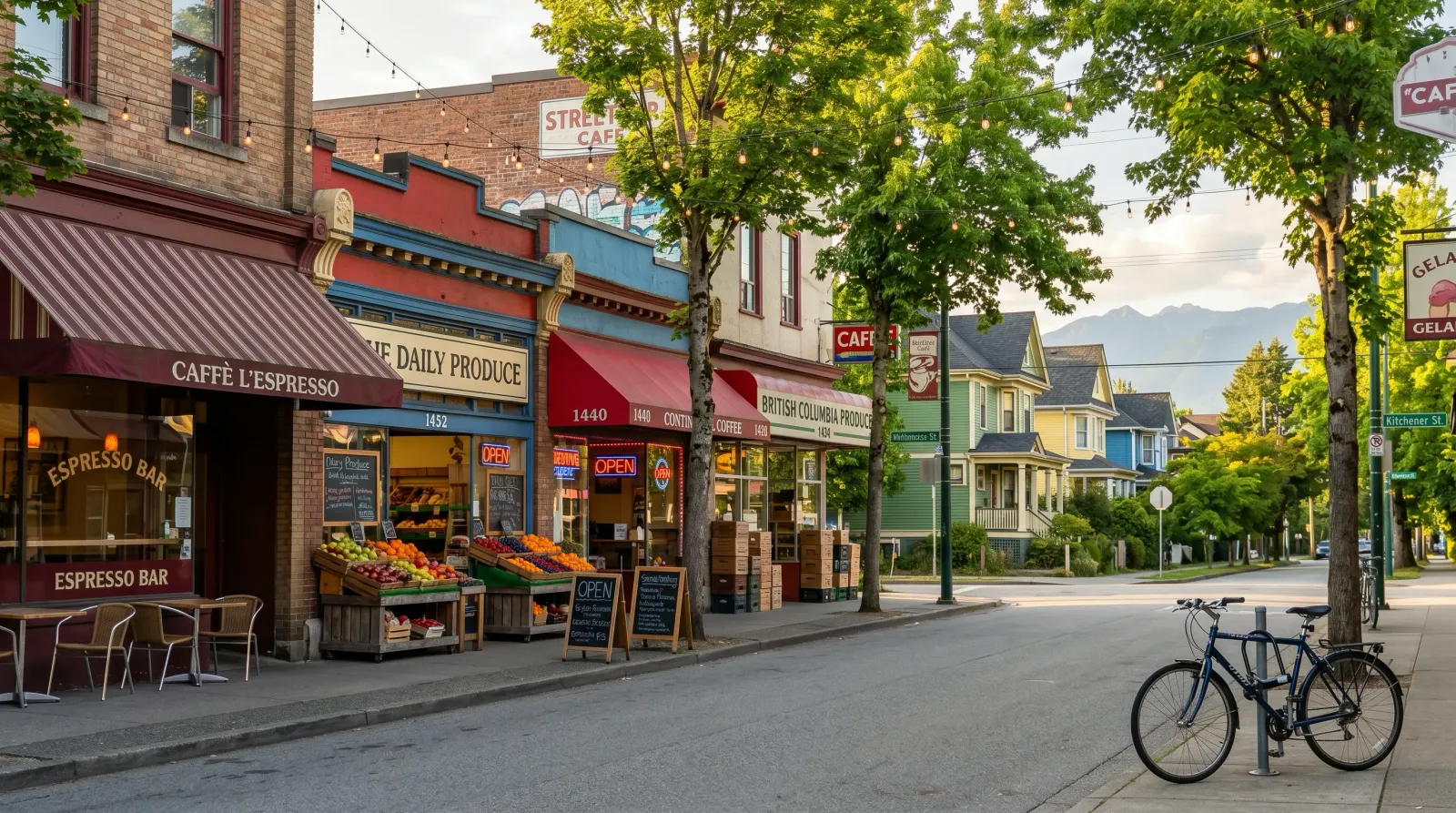
- Walkable commercial spines. Commercial Drive, Main Street between 16th and 33rd, Hastings, and Kingsway have arguably more diverse, less-corporate retail than the west side.
- Closer to downtown for several neighbourhoods. Strathcona, Mount Pleasant East, Commercial Drive — all closer to downtown than Kerrisdale or Dunbar.
- Faster public transit access (in some areas). Commercial-Broadway is one of Metro Vancouver’s busiest transit hubs. The Millennium Line and the upcoming Broadway Subway extension serve east-side neighbourhoods well.
- A more diverse community feel. This is subjective and varies block-to-block, but east-side neighbourhoods generally have more demographic diversity than the west side.
The Three Factors Most Buyers Underweight
When buyers ask me “east or west,” I push back on the way the question is framed. The right answer almost always comes down to three things that have nothing to do with the cultural shorthand.
1. Your school priority
If you have school-age kids and you’re committed to public school (not private, not French Immersion specific), west-side catchment access is worth the premium. If you’re flexible on school choice, French Immersion is your priority, or your kids are pre-K, the school differential is much smaller and east side wins on price.
2. Where you actually commute
Map your most-frequent destinations on a week. If three of five are downtown and you take SkyTrain, east side via Millennium Line or Commercial-Broadway is often faster. If your commute is to UBC or to clients on the west side, the commute math flips.
3. Your budget tolerance and equity timeline
If you’re stretching to the top of your pre-approval to buy west side, your monthly carrying cost will be 30–40% higher than buying comparable east side, with the same income. That stretches your monthly cash flow and your savings rate. If you’ve got a 10+ year horizon and meaningful income growth ahead, west side may be worth the squeeze. If you’re at peak income or your career is volatile, east side gives you breathing room.
Where Each Side Is Heading
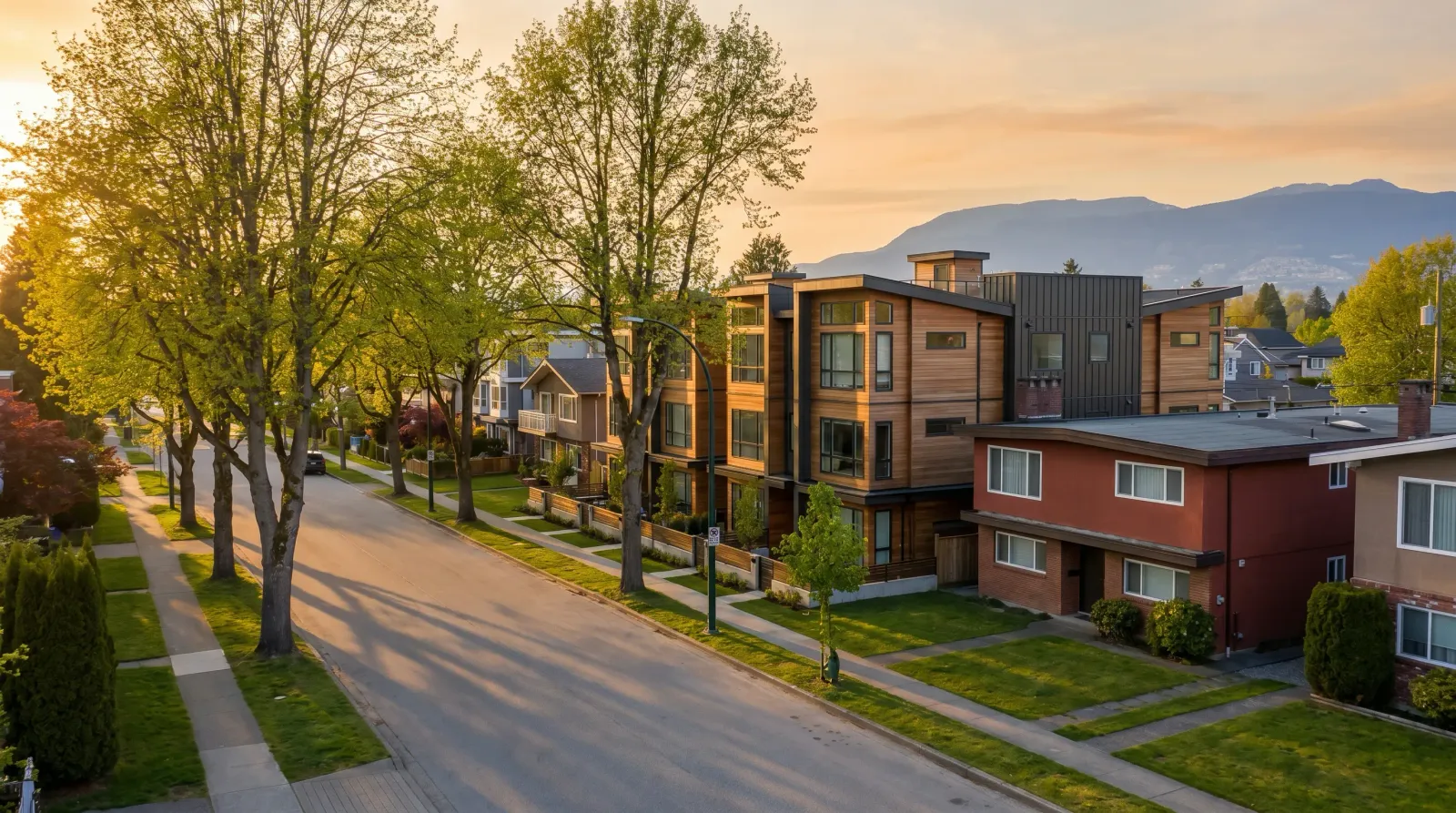
West side: Multiplex development is reshaping standard 33×120 lots in Kitsilano, Mount Pleasant West, Cambie corridor, and Marpole faster than anywhere else in the city. The west-side detached market is bifurcating: large, well-located lots remain premium and command builder demand; smaller or worse-positioned lots increasingly compete with multiplex unit pricing rather than detached comps.
East side: Mount Pleasant East and Commercial Drive continue gentrifying. Hastings-Sunrise has been the surprise of the past five years with significant townhouse and multiplex development. Older single-family-only neighbourhoods like Renfrew and Killarney are now seeing serious multiplex activity following Bill 44 implementation. Investor and developer demand for east-side lots has been the stronger driver in 2026.
I’d argue the east side has more upside in absolute terms over the next 5–10 years. The west side has less room to grow because so much of the premium is already priced in.
Who Should Choose Each Side
| Buyer profile | Recommendation |
|---|---|
| First-time buyer under $800K | East side, almost certainly |
| Family with school-age kids prioritizing public schools | West side |
| Empty-nester downsizing into a 2BR condo | Either — depends on lifestyle preference |
| Investor focused on appreciation potential | East side, with selective west-side multiplex plays |
| Multiplex builder | Either — but east-side lots have stronger underwriting math right now |
| Buyer whose work is at UBC or Burrard Peninsula | West side |
| Buyer whose work is downtown via SkyTrain | East side or Mount Pleasant West |
Key Takeaways
- East-west price differential typically 30–50% per square foot in 2026, varying by property type
- Detached premium is largest (60–80%) because land value is the differentiator
- West side advantages: school catchments, beach/seawall, UBC proximity, heritage, larger lots
- East side advantages: lower entry price, walkable commercial spines, downtown proximity (some neighbourhoods), transit hubs
- Three factors most buyers underweight: school priority, actual commute pattern, budget tolerance
- Multiplex activity is reshaping both sides; east side multiplex pipeline is currently more active
- East side likely has more 5–10 year appreciation upside; west side has less room to grow because more of the premium is priced in
- First-time buyers under $800K should default to east side except in rare cases
Frequently Asked Questions
Where is the dividing line between East Side and West Side Vancouver?
The traditional dividing line is Cambie Street, running north-south through the city. Neighbourhoods west of Cambie are ‘west side’ (Kitsilano, Point Grey, Dunbar, Kerrisdale, Shaughnessy, Arbutus, etc.); neighbourhoods east of Cambie are ‘east side’ (Mount Pleasant East, Commercial Drive, Hastings-Sunrise, Renfrew, Killarney, etc.). Mount Pleasant straddles the line and is technically split into VW (west) and VE (east) sub-areas.
Why is West Side Vancouver more expensive than East Side?
Historical reasons compound: west-side land was developed earlier with larger lots, the school catchments include Vancouver’s most academically ranked public schools, the proximity to UBC drives professional and academic demand, and the legacy West Point Grey/Shaughnessy/Kerrisdale neighbourhoods carry strong heritage premiums. The price differential typically runs 30–50% per square foot, narrowing somewhat in 2026.
Is East Side Vancouver becoming more like West Side?
In some neighbourhoods, yes. Mount Pleasant East and parts of Commercial Drive have seen substantial gentrification and multiplex/townhouse development since 2018, lifting prices into territory that was unimaginable a decade ago. Other east-side neighbourhoods (Hastings-Sunrise, Renfrew, Killarney) remain meaningfully more affordable than west-side comparables.
Are West Side Vancouver schools better than East Side?
On standardized academic rankings, west-side public schools tend to score higher (Lord Byng, University Hill Secondary, Sir Winston Churchill, Lord Tennyson Elementary). However, several east-side schools have strong programs and active parent communities — and Vancouver French Immersion programs are well-distributed across both sides. Catchment quality matters but the gap is smaller than the price differential implies.
Which side has better transit?
Different transit profiles. West side is anchored by the Canada Line (north-south, downtown to Richmond/airport via Cambie corridor and Marpole) and the upcoming Broadway Subway extension. East side is served by the Millennium Line and the Broadway Subway extension when complete (2027 expected), plus extensive bus networks along Hastings, Commercial Drive, and Kingsway. East-side residents in Commercial Drive area arguably have stronger frequent-bus access than most west-side equivalents.
Which side is better for first-time buyers in Vancouver in 2026?
East side, with rare exceptions. First-time buyers under $1M will find more inventory in Mount Pleasant East, Commercial Drive, Hastings-Sunrise, and Renfrew than in any west-side neighbourhood except Marpole. The east-side condo market in particular has more options at sub-$700K than the west side.
Sources
- Greater Vancouver Realtors — April 2026 Monthly Market Report
- Vancouver School Board — School Listings
- TransLink — Schedules and Maps
- Best Vancouver neighbourhoods for families
- Best Vancouver neighbourhoods for investors
Data sourced May 2026. Prices and neighbourhood characteristics evolve. Verify current market conditions for any specific neighbourhood before making a purchase decision.
Run Your Specific Profile Past Me
If you’re trying to decide which side is right for your specific budget, family situation, and commute, I’ll map it out with you. Often the answer surprises people — the side that seemed obvious from the surface-level cultural shorthand isn’t always the right financial or lifestyle choice once we run your real numbers.
Contact Greyden Douglas directly at (604) 218-2289 or book a buyer consultation. Considering both sides? Reach out and I’ll send you specific neighbourhood comparables for your price range — not generic GVR averages.
Frequently asked questions
Where is the dividing line between East Side and West Side Vancouver?
The traditional dividing line is Cambie Street, running north-south through the city. Neighbourhoods west of Cambie are 'west side' (Kitsilano, Point Grey, Dunbar, Kerrisdale, Shaughnessy, Arbutus, etc.); neighbourhoods east of Cambie are 'east side' (Mount Pleasant East, Commercial Drive, Hastings-Sunrise, Renfrew, Killarney, etc.). Mount Pleasant straddles the line and is technically split into VW (west) and VE (east) sub-areas.
Why is West Side Vancouver more expensive than East Side?
Historical reasons compound: west-side land was developed earlier with larger lots, the school catchments include Vancouver's most academically ranked public schools, the proximity to UBC drives professional and academic demand, and the legacy West Point Grey/Shaughnessy/Kerrisdale neighbourhoods carry strong heritage premiums. The price differential typically runs 30-50% per square foot, narrowing somewhat in 2026.
Is East Side Vancouver becoming more like West Side?
In some neighbourhoods, yes. Mount Pleasant East and parts of Commercial Drive have seen substantial gentrification and multiplex/townhouse development since 2018, lifting prices into territory that was unimaginable a decade ago. Other east-side neighbourhoods (Hastings-Sunrise, Renfrew, Killarney) remain meaningfully more affordable than west-side comparables.
Are West Side Vancouver schools better than East Side?
On standardized academic rankings, west-side public schools tend to score higher (Lord Byng, University Hill Secondary, Sir Winston Churchill, Lord Tennyson Elementary). However, several east-side schools have strong programs and active parent communities — and Vancouver French Immersion programs are well-distributed across both sides. Catchment quality matters but the gap is smaller than the price differential implies.
Which side has better transit?
Different transit profiles. West side is anchored by the Canada Line (north-south, downtown to Richmond/airport via Cambie corridor and Marpole) and the upcoming Broadway Subway extension. East side is served by the Millennium Line and the Broadway Subway extension when complete (2027 expected), plus extensive bus networks along Hastings, Commercial Drive, and Kingsway. East-side residents in Commercial Drive area arguably have stronger frequent-bus access than most west-side equivalents.
Which side is better for first-time buyers in Vancouver in 2026?
East side, with rare exceptions. First-time buyers under $1M will find more inventory in Mount Pleasant East, Commercial Drive, Hastings-Sunrise, and Renfrew than in any west-side neighbourhood except Marpole. The east-side condo market in particular has more options at sub-$700K than the west side.
Sources
- Greater Vancouver Realtors — April 2026 Monthly Market Report · industry · accessed 2026-05-05
- Vancouver School Board — School Catchments · government · accessed 2026-05-05
- TransLink — Canada Line and Millennium Line · government · accessed 2026-05-05
Related Vancouver real estate pages
Continue with local service pages, neighbourhood guides, and actionable resources related to this topic.