Quick answer: A 2026 plain-language guide to Vancouver housing terminology under Bill 44, explaining the difference between a multiplex, fourplex, sixplex, and missing middle housing, how the City of Vancouver counts units, and what a standard R1-1 lot permits.
A working realtor's plain-language guide to the words everyone throws around under Bill 44. What a multiplex, fourplex, sixplex, and 'missing middle' actually mean, how the City counts units, and what a typical R1-1 Vancouver lot really allows.
Want a free assessment for your property?
Leave your name and phone — Greyden will call you back with a personalized market snapshot. No spam, no drip campaigns.
Join 1,000+ Vancouver homeowners. No spam, unsubscribe anytime.
A buyer called me last month, excited about a listing that said “fourplex potential.” A week later she sent me a different listing that said “multiplex potential” and asked if that one was better or worse. She thought these were two separate legal categories with different rules. They are not. They are just words for how many homes fit on a lot, and the loose way people use them causes real confusion.
So let me clear it up. This is a plain-language guide to the terms you will see all over Vancouver listings in 2026: multiplex, fourplex, sixplex, and “missing middle.” I will tell you what each one means, how the City counts units, and what a normal lot actually allows under Bill 44.
Start with the simple counts
Most of these words are just numbers with “-plex” on the end. Once you see that, the fog lifts.
- Duplex: two homes on one lot.
- Triplex: three homes.
- Fourplex: four homes.
- Sixplex: six homes.
The “-plex” ending only tells you the number of homes. It does not mean a special zoning class or a different set of rules. A fourplex is not more official than a triplex. It just has one more home.
So what is a multiplex?
“Multiplex” is the umbrella word. It covers any small building with three or more homes on a single lot. A triplex is a multiplex. A fourplex is a multiplex. A sixplex is a multiplex.
Here is the key point: every fourplex is a multiplex, but not every multiplex is a fourplex. When a listing says “multiplex,” it is not telling you the exact number of homes. It is telling you the building type is small-scale and has several units. You still have to ask how many.
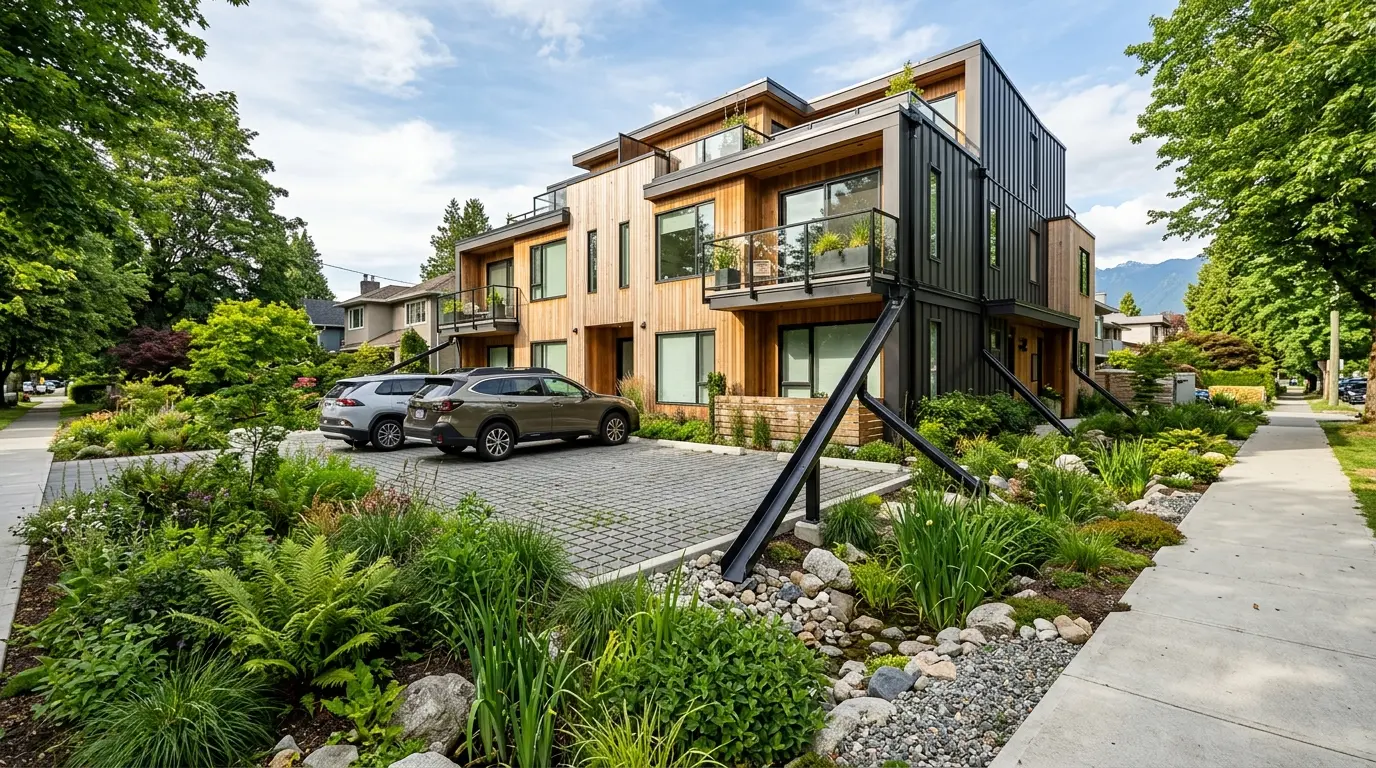
In Vancouver, people usually say “multiplex” to mean the new small buildings, roughly three to eight homes, that Bill 44 now allows on lots that used to hold just one house. That is why the word shows up everywhere this year.
If you want a deeper picture of how these buildings work as an investment or a place to live, our multiplex page goes much further than terminology.
What “missing middle” means
“Missing middle” is not a building type. It is a planning term. It describes all the home types that sit between a single detached house on one end and a tall apartment tower on the other.
Missing middle includes duplexes, triplexes, fourplexes, townhouses, and small multiplexes. It is called “missing” because North American cities spent decades building mostly single houses or big towers, with very little in between. Bill 44 is meant to fill that gap.
So when a planner or a news article talks about “missing middle housing,” they mean this whole family of small, gentle-density homes. A multiplex is one example of missing middle. The terms overlap, but they are not the same thing.
How the City counts units
This is where buyers get tripped up, so read carefully.
Under the new rules, every self-contained home on the lot counts toward your total. A self-contained home means a unit with its own kitchen, bathroom, and separate entrance.
That means:
- The main house counts.
- A basement suite counts.
- A laneway home in the back counts.
So a lot with a main house, a basement suite, and a laneway home already has three units. If you are planning a project, you cannot treat the suite and the laneway as “extras” on top of the allowed number. They are part of the number.
This changes how you read an older listing. A tired house with a basement suite and a laneway home in the back is not a single-family property with two bonuses. It is a three-unit site. Our explainer on laneway homes in Vancouver walks through how those back units fit into the newer rules.
What a typical R1-1 lot allows
Here is the headline that all the jargon is hiding.
Most standard single-family lots in Vancouver now carry R1-1 zoning. Under BC’s Bill 44 housing legislation and the City of Vancouver’s matching zoning, a typical R1-1 lot allows up to eight units. That is a small-scale multiplex.
A few things shift the number:
- Lot size. Very small lots may support fewer units. Larger lots hit the higher counts more easily.
- Corner lots. A corner lot can sometimes support more homes because it has two street frontages to work with.
- Distance to frequent transit. Lots close to fast, frequent bus or SkyTrain service can allow more density in some cases.
The word “multiplex” on a listing could therefore mean three units or eight units. The value of the land is very different at each end of that range. This is exactly why terminology matters for your money. Our explainer on R1-1 zoning in Vancouver breaks down the units, setbacks, and practical limits in detail.
Why the loose wording costs buyers money
Let me be direct about the risk. When a listing says “fourplex” or “multiplex potential,” that word is doing marketing work, not legal work.
“Potential” means the seller believes the lot could support a project. It does not confirm the exact unit count, and it does not promise the numbers will work once you add construction costs, setbacks, and parking. A lot that “could” hold eight units might only pencil out for six once a designer looks at the real constraints.
So treat the “-plex” word as a starting point, not a fact. Then ask the two questions that actually matter: how many units does the City confirm for this specific lot, and do the construction numbers work at that count? If you are thinking of buying a lot to build, our buyers guide covers how to do that due diligence before you write an offer.
Key Takeaways
- The “-plex” words are just counts: duplex is two homes, triplex three, fourplex four, sixplex six.
- Multiplex is the umbrella term for any small building with three or more homes, so every fourplex is a multiplex, but not every multiplex is a fourplex.
- “Missing middle” is a planning term for all the home types between a single house and a large tower, including small multiplexes.
- The City counts every self-contained home on the lot, so a main house, a basement suite, and a laneway home already make three units.
- A typical R1-1 lot allows up to eight units under Bill 44, with lot size, corner position, and transit distance shifting the number.
- Words like “multiplex potential” are marketing, not a guarantee. Confirm the real unit count with the City before you buy.
Frequently Asked Questions
What is the difference between a multiplex and a fourplex in Vancouver?
Fourplex means a building with exactly four homes. Multiplex is a broader word that covers any small building with three or more homes on one lot, so a fourplex is one kind of multiplex. In Vancouver, people often say multiplex to mean the new small buildings of three to eight units now allowed under Bill 44, without fixing the exact count.
How many units can you build on a typical R1-1 lot in Vancouver?
On a standard R1-1 lot, BC’s Bill 44 rules and the City of Vancouver’s zoning allow up to eight units, which is a small-scale multiplex. Larger corner lots or lots close to frequent transit may allow more. The final number depends on lot size, setbacks, parking, and design rules, so confirm with the City for any specific property.
What does “missing middle” housing mean?
Missing middle is a planning term for home types that sit between a single house and a large apartment tower: duplexes, triplexes, fourplexes, townhouses, and small multiplexes. It is called missing because North American cities stopped building much of it for decades. Bill 44 is meant to bring it back.
Is a duplex a multiplex?
No. A duplex has two homes, and most people and the City treat two-unit buildings as a separate category. Multiplex usually starts at three units. A triplex has three, a fourplex has four, and Vancouver allows up to eight on many standard lots.
Does a basement suite or laneway home count as a unit?
Under the new rules, every self-contained home on the lot counts toward the total. So a main house, a basement suite, and a laneway home can together make up three of your allowed units. This is why counting units correctly matters before you plan a project. Confirm the exact count with the City of Vancouver.
Sources
- Province of BC: small-scale multi-unit housing (Bill 44)
- City of Vancouver: home and property development
- City of Vancouver: multiplex housing
- City of Vancouver: zoning and land use documents
Work with Rain City Properties
Terminology sounds like a small thing until it costs you on a purchase. If you are reading listings this year and want a straight answer on what a specific lot actually allows, I can confirm the unit count with the City, explain what “multiplex potential” really means for that address, and help you decide whether the numbers work.
Contact Greyden Douglas directly at (604) 218-2289 or book a call to discuss your Vancouver real estate goals.
Frequently asked questions
What is the difference between a multiplex and a fourplex in Vancouver?
Fourplex means a building with exactly four homes. Multiplex is a broader word that covers any small building with three or more homes on one lot, so a fourplex is one kind of multiplex. In Vancouver, people often say multiplex to mean the new small buildings of three to eight units now allowed under Bill 44, without fixing the exact count.
How many units can you build on a typical R1-1 lot in Vancouver?
On a standard R1-1 lot, BC's Bill 44 rules and the City of Vancouver's zoning allow up to eight units, which is a small-scale multiplex. Larger corner lots or lots close to frequent transit may allow more. The final number depends on lot size, setbacks, parking, and design rules, so confirm with the City for any specific property.
What does 'missing middle' housing mean?
Missing middle is a planning term for home types that sit between a single house and a large apartment tower: duplexes, triplexes, fourplexes, townhouses, and small multiplexes. It is called missing because North American cities stopped building much of it for decades. Bill 44 is meant to bring it back.
Is a duplex a multiplex?
No. A duplex has two homes, and most people and the City treat two-unit buildings as a separate category. Multiplex usually starts at three units. A triplex has three, a fourplex has four, and Vancouver allows up to eight on many standard lots.
Does a basement suite or laneway home count as a unit?
Under the new rules, every self-contained home on the lot counts toward the total. So a main house, a basement suite, and a laneway home can together make up three of your allowed units. This is why counting units correctly matters before you plan a project. Confirm the exact count with the City of Vancouver.
Related Vancouver real estate pages
Continue with local service pages, neighbourhood guides, and actionable resources related to this topic.